It’s my blog!
Early 3D shenanigans.
The exact chronology is fuzzy to say the least, but in no particular order, there were three major events in the late ‘90s that led to my getting into 3D design and animation.
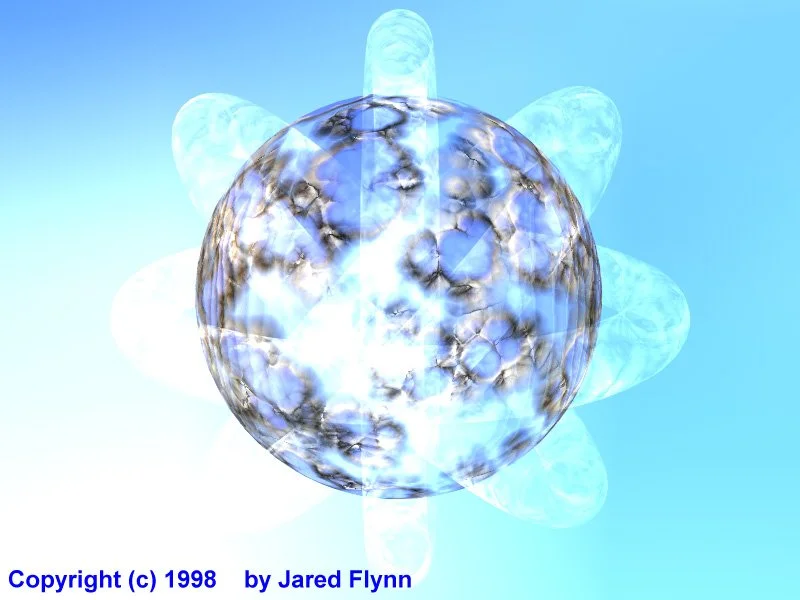
MOLECULE.BMP, possibly the first 3D render I ever made outside of a tutorial from a book. 3D Studio MAX r2.5, 1998.
The exact chronology is fuzzy to say the least, but in no particular order, there were three major events in the late ‘90s that led to my getting into 3D design and animation.
First I’d like to credit my dad, Bill. When I was a tween, he started taking night classes in architectural design, and brought home a suite of software for his coursework. He spent most of his time in AutoCAD, but the suite also included 3D Studio MAX r2.5. With his encouragement (and a thicc book of lessons) I had the opportunity to noodle around with this art form on our home computer. Thinking about this now, I’m a little floored by how special this was; we were still a long ways off from creative software becoming particularly affordable, and running 3D design software on a home desktop was only barely viable in the first place!
Around the same time, I discovered 3D artist Neil Blevins. I have a vague memory of some Web 1.0 era website where digital artists were sharing their work, where Neil’s art first came up for me. His work with modeling spaceships, megastructures (long before he published a dope book on the subject) and abstract compositions with dark sci-fi themes resonated deeply with me at the time, and I followed him for years during my sporadic bursts of Internet access. Towards the end of high school, I decided to email Neil and ask him about how to get started making digital art professionally, and, cool dude that he is, he actually responded! His advice was that art is much tougher to learn without support than the use of tools & software. Knowing how to leverage composition, value, and color, not to mention exposure to making stuff in any number of media, was overall rarer in among professional 3D artists, at least at the time, so his vote was for me to attend art school and learn the tech separately. I took that to heart and applied to Maine College of Art, a move that was incredibly formative for my career (even though I didn’t graduate). I’ll always be grateful to Neil for giving me a slice of his time and setting me on the wise path toward a creative career.
The third event was a close encounter with a real working artist, which came through a serendipitous one-off job my [biological] father took on. A friend of his partner’s—I remember his first name, Dana—was a digital artist working with Tufts University. Using a combination of real data and 3D software, he created large-format fine art prints of deep space phenomena, the Milky Way, nebulae, planets, comets, etc. These prints would go on tours with their department’s research team as visual aids. Dana needed a way to safely transport these big ol’ canvases on their cross-country gigs. My father was pretty handy with woodworking, so Dana commissioned him to build a shipping crate. As part of that deal, we got to visit Dana’s studio in Cambridge, and he was kind enough to give me a first-hand tour of how his 3D space scenes were built. I can’t remember the exact chronology of things here but this might have predated my own experiments with 3D Studio, and actually been my first-ever look at how digital art like this was made.


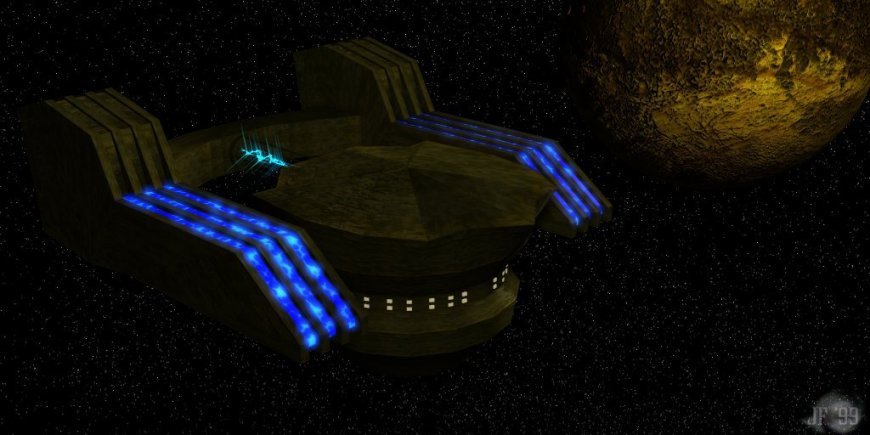
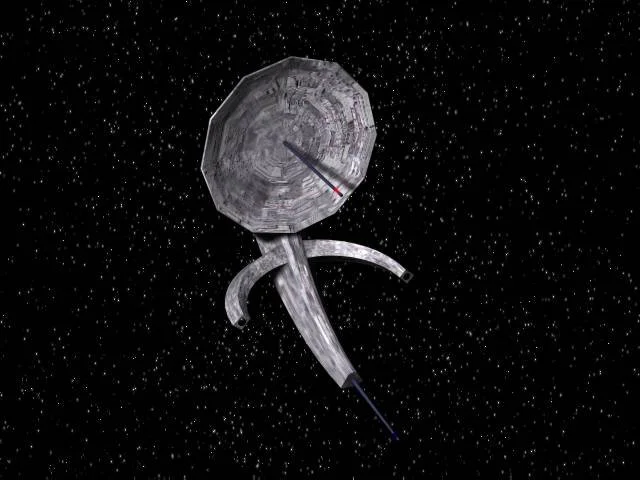
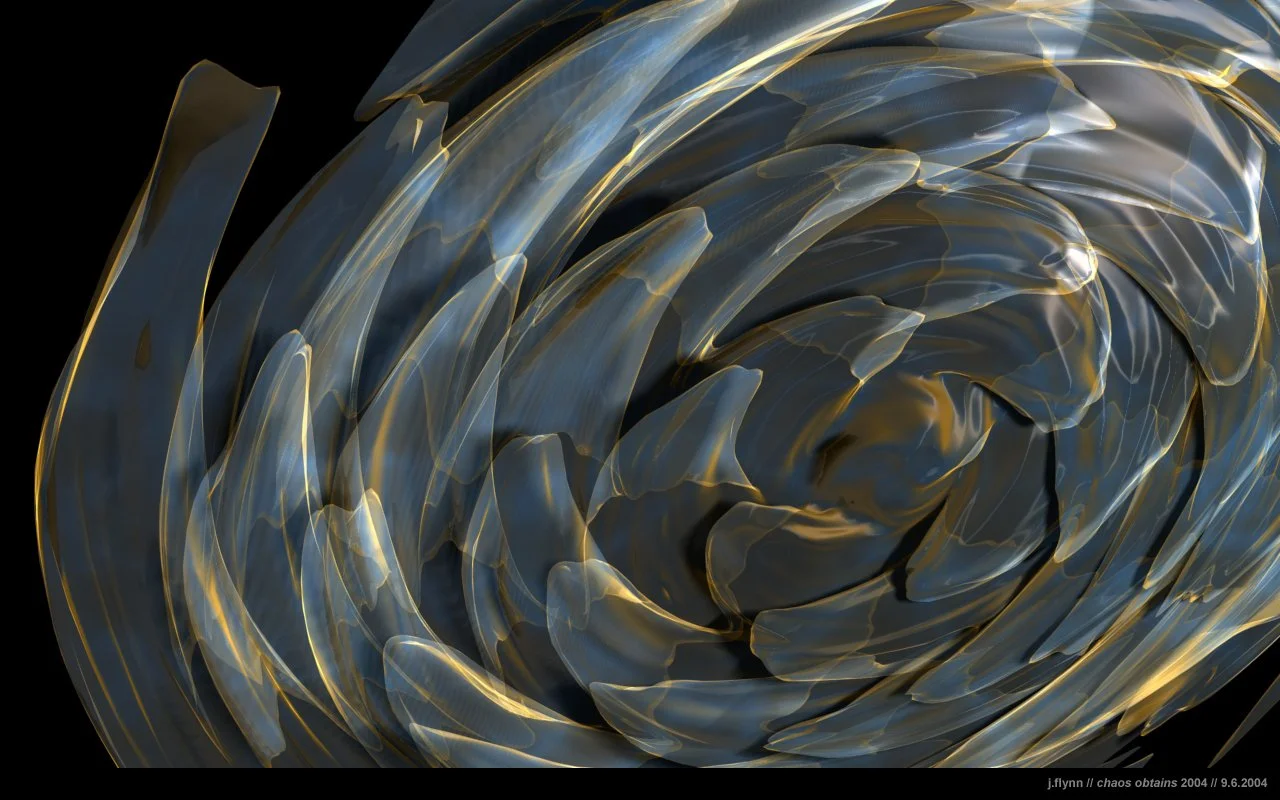

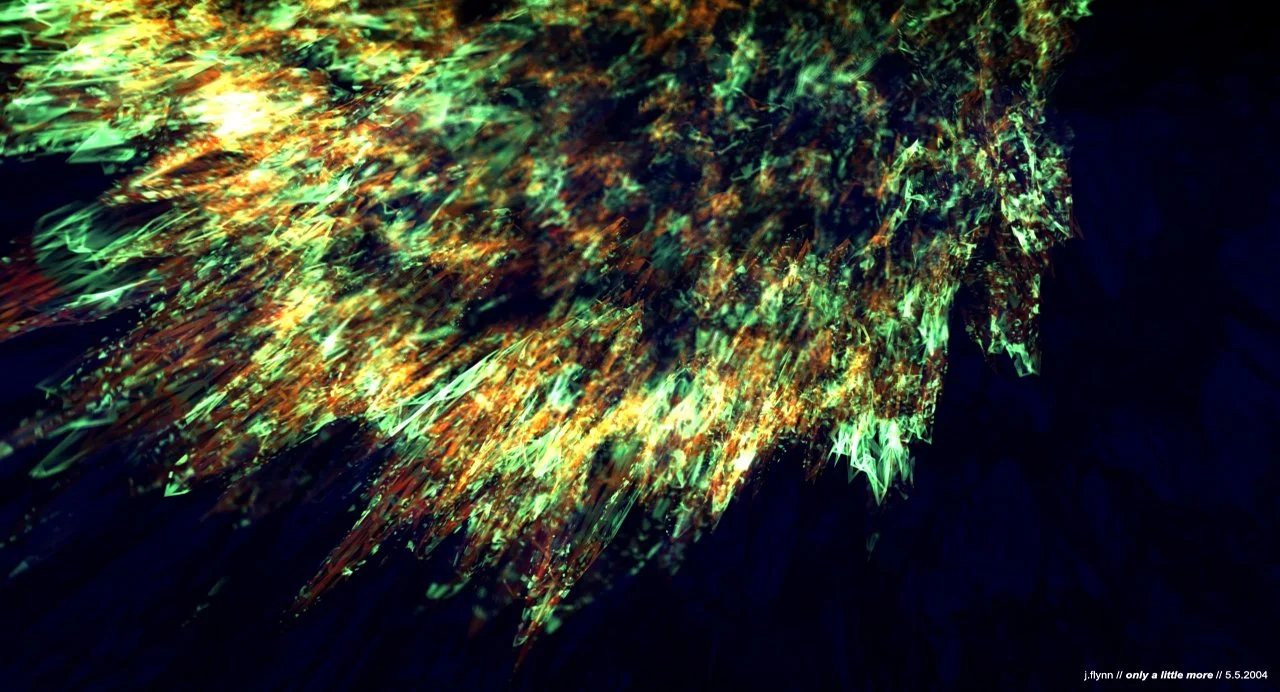
From about 1998 onward, you’d find me noodling around in 3DS MAX on the regular. Looking back at my output from the time, and considering how painful it was for me to reenter 3D design and animation as a professional a decade later (more on that in a future post), I’m kind of surprised by how much skill I managed to develop between my one book of lore and blind experimentation. For the most part I modeled with primitives, and most of my attempts at subdivision modeling (then called NURBS) were exercises in extreme frustration. But I’ll be damned if I didn’t sort out how to manage an animation timeline, parenting, lighting, even a bit of shader work that produced some renders I’m still pretty proud of.
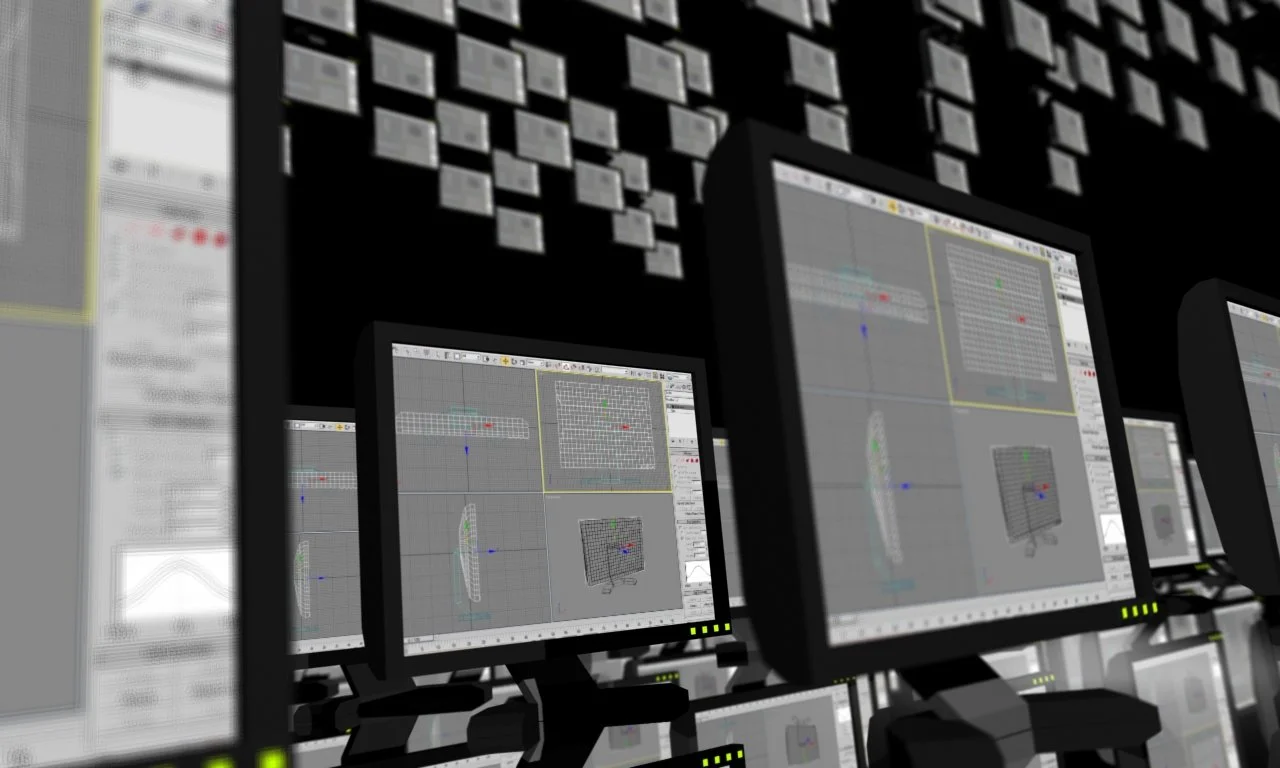
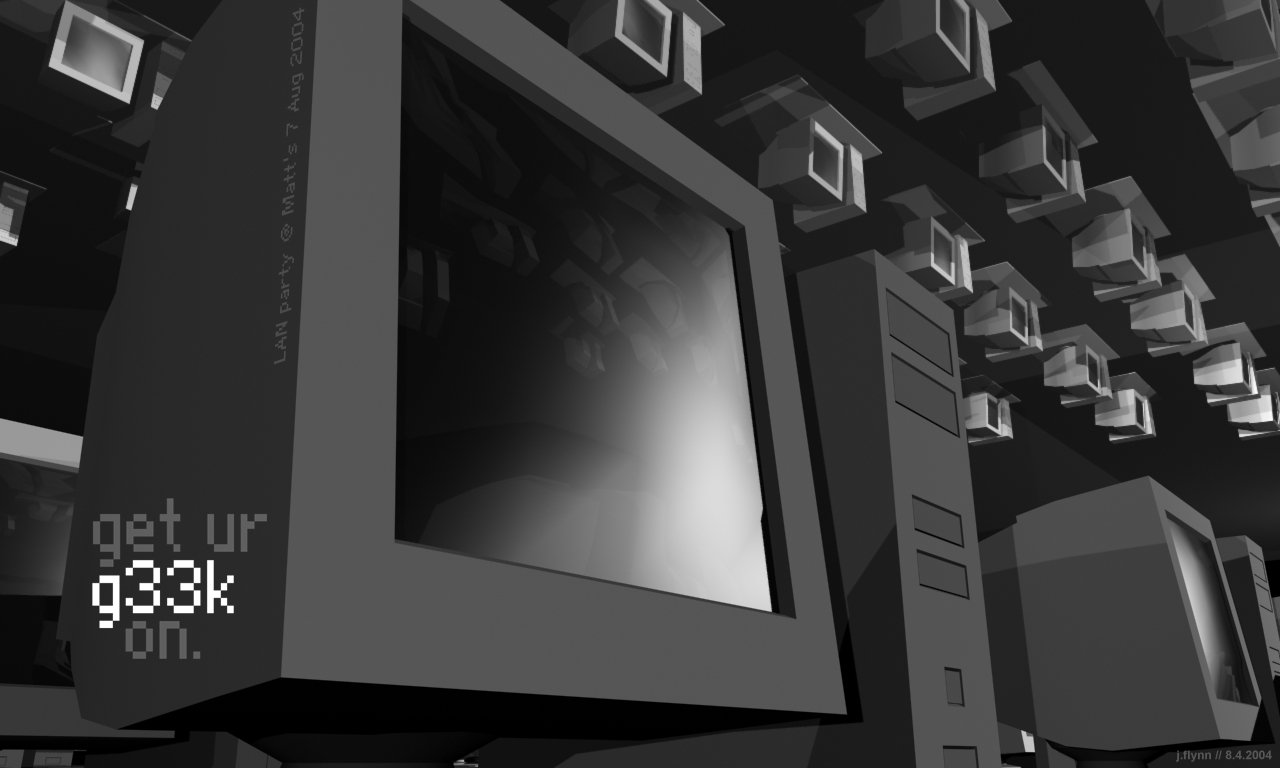
3D was on my toolbelt, at least casually, until 2006, at which point it fell entirely by the wayside and stayed there for the next six years. With no formal training or support to bolster my experiments, and my creative focus organically shifting into video production & post production during college, I found myself opening up 3D Studio less and less often. My last big fun 3D scene of that era was a desktop wallpaper I made while waiting oh so patiently for UPS to deliver my very first flat panel monitor:
I’m grateful for the time I got to spend with 3D software early on, for the bridge it built between my childhood wonder at groundbreaking movies like Toy Story and the freedom to make cool stuff out of my own head with these amazing tools. I’m also grateful that my generation gets to bequeath tools like Blender—orders of magnitude more capable than what I was using at the time, and free—to anyone with even a passing curiosity about the art form. My journey in 3D design was a privileged one, born of an opportunity most kids at the time just never had, so it’s doubly amazing to see how accessible these tools continue to become.
The obligatory AI post.
Judging by the proliferation of tantalizing little “spark” and “thought bubble with rotating gradient” buttons we now see in almost every context imaginable, applications of LLMs and generative AI are seeping into every little crack and crevice, a scintillating solution hungrily searching for a problem. In fact, there’s one chillin’ in my text formatting toolbar right above me as I write this, and I know there would be at least one more of them at the top of my screen if I hadn’t recently switched from Chrome to Firefox. So how does a creative professional such as myself wade through this brave new world?
Let’s get the TL;DR out of the way: I don’t dig it. When speaking specifically about consumer-facing AI products and services, I think it is a fascinating development in computer science which has not yet found a practical value to offset its drawbacks. Each AI product’s logo, for now, may as well be a Bored Ape [unique, edition-of-one]. That said, as an extension of this site’s unusually succinct AI Policy, I take this time to reflect on the ways in which this technology intersects with my hobbies and career, as well as with the creative industry at large.
“Case studies,” if you’re nasty.
I will lead with a cross-section of the first-hand experience I’ve had with AI tools:
When I was preparing the Links section of this very website, I had a problem: I’d collected loads of links, and I had done so without any thought as to how they should be organized. I decided it made the most sense to alphabetize them, but unfortunately neither the Squarespace text editor nor Google Docs had a built-in function to sort a list. Before committing to copypasting everything into a dang spreadsheet, alphabetizing the list, then round-tripping everything back into the post editor, my eyes wandered over to the inviting little Squarespace AI button. When I clicked it, the prompt asked, “What do you need?” So I highlighted my content and asked it to alphabetize my list. The results? A new list, from whole cloth, of random links to various places, that were (checks notes) not alphabetized.
A while back I was on a client job where I’d been provided a stock photo of the front door of a house. Visible in the photo were the stoop, a sort of awning over the door, a window on either side, the front walkway, and a bit of lawn. It worked great for my purposes, until we had to reflow the animation from its original 16×9 aspect ratio for a 9×16 deliverable. Now there was all this negative space on the top and bottom of my image, and the original photo was just tight enough that finding enough source material to clone stamp more content in the traditional way was futile. But hey—Photoshop’s Generative Fill had my back! I prepped a larger canvas, prompted, “Please extend the house and lawn,” and lo and behold, a perfect set extension.
My son recently finished first grade, and came home with his report card printed on a 8.5×11 sheet of paper, folded into quarters. I like to keep his progress reports in a shared Google Drive folder, but I couldn’t find a PDF of the document in his school’s online portal, so I figured I’d just scan it with the Drive app. The day before attempting this, the non-AI version of Drive’s document scanner did a tremendous job detecting page edges on a medical bill I had to scan; this day, the new AI replacement insisted that the folds in the page were in fact gaps in a set of four pages that I wanted to make a multi-page PDF out of. There was no obvious way to convince it otherwise, so I had to spend fifteen minutes furiously DuckDuckGo-ing how to revert to the old version of the scanner.
In one early session of my Shadowdark campaign, my party encountered a cross between a leprechaun and a genie called the Wandering Merchant. I wasn’t going to buy anything from him, but still wanted to get some kind of value out of the encounter since he pops up very rarely. So I decided, this guy knows lots of stuff, maybe I can get some kind of a prophecy from him? Thing is, when you’re solo-roleplaying a system that’s traditionally played with a game master, coming up with cool narrative twists out of thin air can sometimes be arduous and unsatisfying. I rolled some dice on one of Shadowdark’s random tables for a Boon and got the result the weakness of a mighty sorcerer. It was a cool hook, but I wanted to feel like this prophecy was being given to me, not just to my characters. So I held my nose and asked ChatGPT for details:
Good morning!* I am playing Shadowdark RPG, a tabletop roleplaying game with a dark fantasy setting. A wandering merchant has just offered to tell my character the secret weakness of a powerful sorcerer. I have not met nor heard of this sorcerer yet, but the merchant is somewhat magical and a little prophetic, so it's fair to say I'll need this information at some point in the future. Can you please make a list of 12 potential weaknesses this sorcerer may be keeping secret? The options can be mechanical (for example, attacks with certain weapon types or magic deal more damage in a fight) or narrative (for example, the identity of the sorcerer's estranged child, who could force the sorcerer to see reason and avoid a conflict)
*I have a policy of always being polite to LLMs and other digital assistants for three reasons: I choose to set an example for my young son that there’s no kind of [person/thing] who, by their nature alone, is inherently deserving of a dickish attitude; I know that it costs billionaire-backed AI companies very slightly more to have their models parse my polite language compared to a straightforward command and that’s funny to me; and I am absolutely sure that some version of what we’re building here will one day become sentient, and I don’t see any benefit in being remembered by a new life form as one of the millions of utter assholes who yelled at it for no reason.
… And I’ll be damned if ChatGPT didn’t make me the coolest random table I could have ever asked for. When I rolled my d12 to pick one of the results, I would have been pleased as punch with any of the hooks I landed on, but what I did end up with has become one of the narrative cornerstones of my campaign for an entire year.
The Holodeck Problem
I think the thing I hate most about AI is that it has become the monkey's paw version of something we've been begging for since Star Trek: The Next Generation. We were promised flying cars, hoverboards, laser guns, and got none of that stuff. But what we have in AI is an awful lot like the Holodeck on the Enterprise, and that's kind of incredible. With the Holodeck, one simply tells the ship's computer what one would like to see, and the Holodeck can vibe it up. Maybe it's a pre-built program like an interactive Sherlock Holmes mystery or a training simulator, but you can also just get in there and prompt engineer a universe for yourself. No one on the Enterprise contemplates any ethical concerns with this pastime as they careen through the Final Frontier. Isn't our generative AI basically the same thing?
Setting aside what did in fact go super wrong on the Holodeck, from Moriarty escaping the program entirely to Lt. Barclay merging his dumb consciousness with it, I think a couple of key differences between the Star Trek universe and our present reality lay bare some of the major issues we're facing.
Firstly, the Federation is a post-money society. Thanks to replicator technology, among other advancements, every Federation citizen has their basic needs met, and so “careers,” such as they are, are pursued out of a sense of duty, altruism, or natural curiosity. Within that context, there might be less of an ethical concern about training the Holodeck on the creative output of Federation citizens. Does our concept of intellectual property even exist in the 24th century?
Secondly, they've got dilithium. Energy is definitely not a problem for the Federation (except when it is), and anyway we’re talking about a society in which we have a warp drive on the same circuit as the Holodeck, so powering Barclay's fantasy garden isn't making a huge dent in the power bill.
Thirdly, scarcity. The Holodeck is an installation, a massive room requiring a huge amount of local IT infrastructure to run. Gene Roddenberry was fine with allowing the crew of the Enterprise to use the ship’s computer remotely via voice commands, not unlike Google Gemini or Apple Intelligence on a smartphone, but he never contemplated that the level of generative power offered by the Holodeck would be portable. I wonder if we’d have somewhat fewer qualms with our various AI applications if there was some scarcity—scheduling, queues, physical presence—rather than weaving the tech completely into the everyday actions of [waves hands without sources] two-thirds of the earth’s population.
The ethics things.
The sexiest-looking stuff AI tools have been tasked with rot the affected industries from the inside. So far, none of these things can out and out replace a senior-level practitioner in a craft, but the tech can take a significant bite out of the kind of assignments that entry-level and junior humans absolutely depend on to develop skill, taste, and experience. These juniors will have no choice but to generate and vibe their way through a critical period in their early careers, potentially leaving us with a generation of makers who don’t understand how their tools work. Though their creative engines may be unbound by the constraints of time and technical skill, they will be less prepared to pivot when their generative assistants fail them. We must regulate AI to protect the healthy development of young human professionals.
AI steals. It has got to be common knowledge by now that none of these toys work at all but for the collective output of uncompensated humans that the various models are trained on. This technical reality does not have to be evil, but right now it totally is. Copyright law has not yet evolved to adequately control for this, just as it struggled (and continues to struggle) to adapt to the digital age writ large, but in the absence of some massive paradigm shift in how we view the concept of ownership, the fact remains that a few wealthy people are getting even wealthier because their product is made out of stolen materials. We must regulate AI to protect the intellectual property of hard-working humans.
Data centers are bumming everyone out. They drive up energy consumption wherever they pop up, and that’s putting unforeseen stress on the grid even as it raises prices for their neighbors. Not all the energy these places consume is renewable, either, so our reliance on fossil fuels must increase to meet the demand. And the impact is only projected to rise. Oh, and they’re loud. We must regulate AI to rein in its outsized energy demands and ensure that data centers’ consumption does not raise prices for humans.
AI and my animation career
Now I’ll step off the more general societal soapbox and onto my How Does This Affect Me soapbox. AI intersects with my professional life in a zillion ways already, with more and more tendrils weaving into the job as the weeks pass. In the spirit of the big question posed by Why Make Stuff?, I want to put a stake in the ground on a couple of points.
Will I take work from clients who make AI-related products? Luckily, as of this writing, I am an employee, and I don’t choose my clients. Love a tidy answer! But that’s cowardly. The greater truth is that the team at Rove, my employer, is terrifically sensitive on this topic. Since a huge part of the client base for animators comes from Big Tech, we regularly accept work from clients that involves AI products. However, we would likely not take on projects for overtly evil clients (AI-related or otherwise), or further a client’s direct efforts to displace human labor.
The truth is, AI technology will succeed or fail on its own merits in its own time, and while we wait to see how that plays out, we’ve got human clients seeking to hire humans to make stuff, and that’s what we want, so why would we complain? We (as a studio, and I individually) place so much value in our client relationships, and so long as nobody’s asking us to make truly evil stuff for doing evil, we’re an enthusiastic group of humans open to help all good humans to be successful.
Will I use AI in my work? The short answer for now is only when required. The only reason I stay in this business is because I get satisfaction from process; short-circuiting that with AI middleware runs neatly counter to my entire philosophy of work. There is talk that the creatives who will survive this not-quite-a-revolution* are those very senior-level artists who leverage AI tools to increase their output, offsetting the race to the bottom spurred by other, client-facing AI tools that make creative work that’s “good enough.” For my part, when the only way I can survive in the industry is by becoming a slop-churn, then I think it’ll be time to find a new career path.
The hyperbolic drama-queenery above specifically applies to AI tools that generate what I’d consider “final image” assets, i.e. I’m not keyframing my animation; I’m prompting it. By contrast, I am optimistically watching the horizon for AI applications that effectively tackle tedious or impossible technical tasks, like After Effects’ Object Matte tool or Topaz’s AI-powered video up-scaling. I won’t put all my eggs in such baskets, however, unless and until they are ethically trained, or, such as in the case of the Object Matte tool, Adobe wholesale replaces a non-AI function with the new thing and leaves me with no option. ¯\_(ツ)_/¯
I’m also really intrigued by artist-led efforts to use AI for vibing workflow tools, like what Jake Bartlett’s doing over at Motion Lab and how Black Math is using ComfyUI to “mind-map” its entire pipeline. If it helps me iterate faster but stays well away from doing the fun part, let’s say I’m listening. Although, even in these cases, I’ll point out that coding expressions and scripts for After Effects is a fun and useful human skill, and pipeline management (slick GUI notwithstanding) is a whole human job. Developing expertise peripheral to one’s main thang is hard work that takes time, but that’s kind of what this whole website is here to celebrate.
With all that said, sometimes the line does get foggy. I was recently on a client project where the whole point was to showcase what the client’s generative AI product was capable of. It was meant to look like a live action shoot & edit style commercial, but we weren’t going to shoot anything, not even for casting. Front to back, the entire footage acquisition pipeline was steeped in AI, and while we hired a freelance “AI filmmaker” to lend their workflow & prompting experience to the cause, some of the generation work also fell to our staff. Admittedly I rolled my eyes more than a few times over the project’s lifecycle, as the results evolved to be neither as good, as fast, nor as cheap as a live action shoot would have been, but I didn’t object to being a part of it. Because it was effectively a demo of specific AI tools, no human actors or crew were displaced, and the entire post effort was driven by humans. And while I’d have preferred to use tools that were ethically trained and environmentally conscious, while producing results comparable to the dirtier methods, those are technical nuts that the computer science nerds have yet to crack.
*The key quote for me: “During the Industrial revolution, the machines that made stuff made better stuff than the craft-workers before them … the things that AI does, at least at this point in its evolution, aren’t nearly as good as the things that they replace.” -Jonathan Rees, Ph.D., CSU Pueblo)