It’s my blog!
Élégie / Massenet
This composition recorded March 21, 2024.
Élégie in E minor - Jules Massenet
Moog Etherwave; Keeley Parallax
Piano accompaniment by Héctor Valls via Petrucci Music Library / Creative Commons Attribution-NonCommercial 4.0
Albert Glinsky tells us in his wonderful book Theremin: Ether Music & Espionage, that Massenet’s Élégie was one of the very first melodies Leon Theremin experimented with when the circuit he built to measure “the density and dialectric constant of gases under varying conditions of pressure and temperature,” began to show promise as a musical instrument. This bite-sized composition felt like a must-learn for me on my theremin journey. I’ll admit, even with a couple years’ practice on this one, the huge jumps between some notes at its insistent tempo still consistently throw me, but it’s a sound I love and a challenge I welcome in my practice.
Early 3D shenanigans.
The exact chronology is fuzzy to say the least, but in no particular order, there were three major events in the late ‘90s that led to my getting into 3D design and animation.
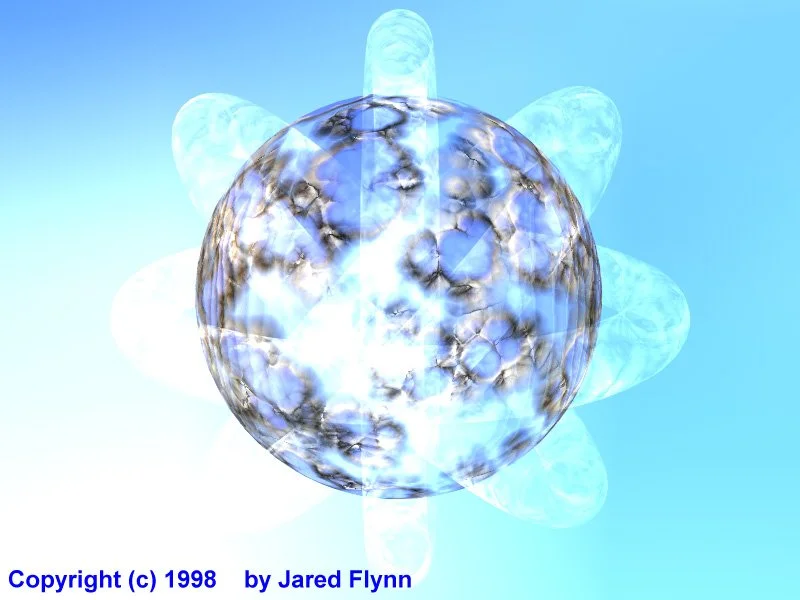
MOLECULE.BMP, possibly the first 3D render I ever made outside of a tutorial from a book. 3D Studio MAX r2.5, 1998.
The exact chronology is fuzzy to say the least, but in no particular order, there were three major events in the late ‘90s that led to my getting into 3D design and animation.
First I’d like to credit my dad, Bill. When I was a tween, he started taking night classes in architectural design, and brought home a suite of software for his coursework. He spent most of his time in AutoCAD, but the suite also included 3D Studio MAX r2.5. With his encouragement (and a thicc book of lessons) I had the opportunity to noodle around with this art form on our home computer. Thinking about this now, I’m a little floored by how special this was; we were still a long ways off from creative software becoming particularly affordable, and running 3D design software on a home desktop was only barely viable in the first place!
Around the same time, I discovered 3D artist Neil Blevins. I have a vague memory of some Web 1.0 era website where digital artists were sharing their work, where Neil’s art first came up for me. His work with modeling spaceships, megastructures (long before he published a dope book on the subject) and abstract compositions with dark sci-fi themes resonated deeply with me at the time, and I followed him for years during my sporadic bursts of Internet access. Towards the end of high school, I decided to email Neil and ask him about how to get started making digital art professionally, and, cool dude that he is, he actually responded! His advice was that art is much tougher to learn without support than the use of tools & software. Knowing how to leverage composition, value, and color, not to mention exposure to making stuff in any number of media, was overall rarer in among professional 3D artists, at least at the time, so his vote was for me to attend art school and learn the tech separately. I took that to heart and applied to Maine College of Art, a move that was incredibly formative for my career (even though I didn’t graduate). I’ll always be grateful to Neil for giving me a slice of his time and setting me on the wise path toward a creative career.
The third event was a close encounter with a real working artist, which came through a serendipitous one-off job my [biological] father took on. A friend of his partner’s—I remember his first name, Dana—was a digital artist working with Tufts University. Using a combination of real data and 3D software, he created large-format fine art prints of deep space phenomena, the Milky Way, nebulae, planets, comets, etc. These prints would go on tours with their department’s research team as visual aids. Dana needed a way to safely transport these big ol’ canvases on their cross-country gigs. My father was pretty handy with woodworking, so Dana commissioned him to build a shipping crate. As part of that deal, we got to visit Dana’s studio in Cambridge, and he was kind enough to give me a first-hand tour of how his 3D space scenes were built. I can’t remember the exact chronology of things here but this might have predated my own experiments with 3D Studio, and actually been my first-ever look at how digital art like this was made.
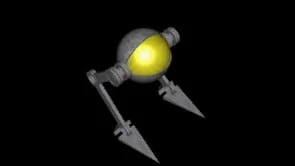

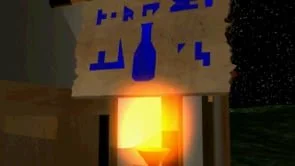
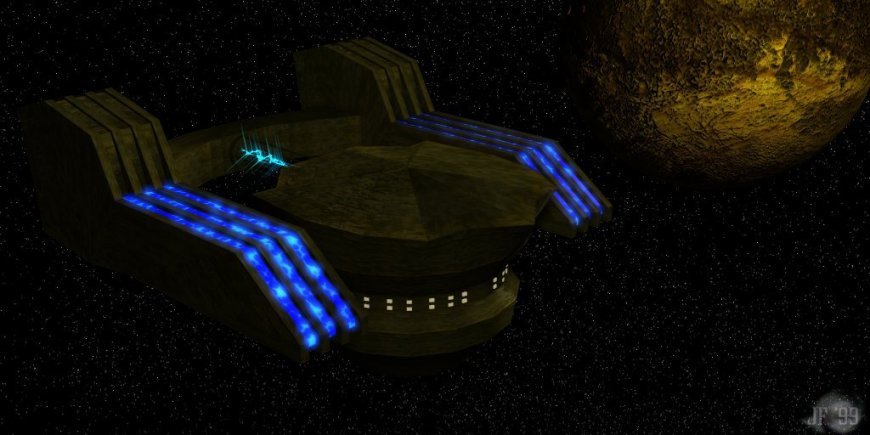
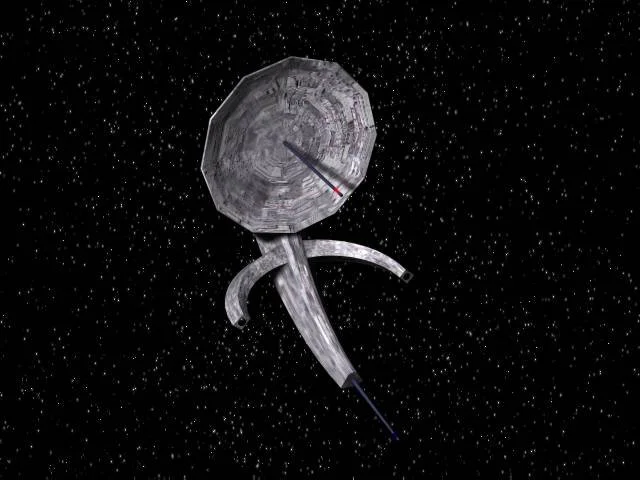

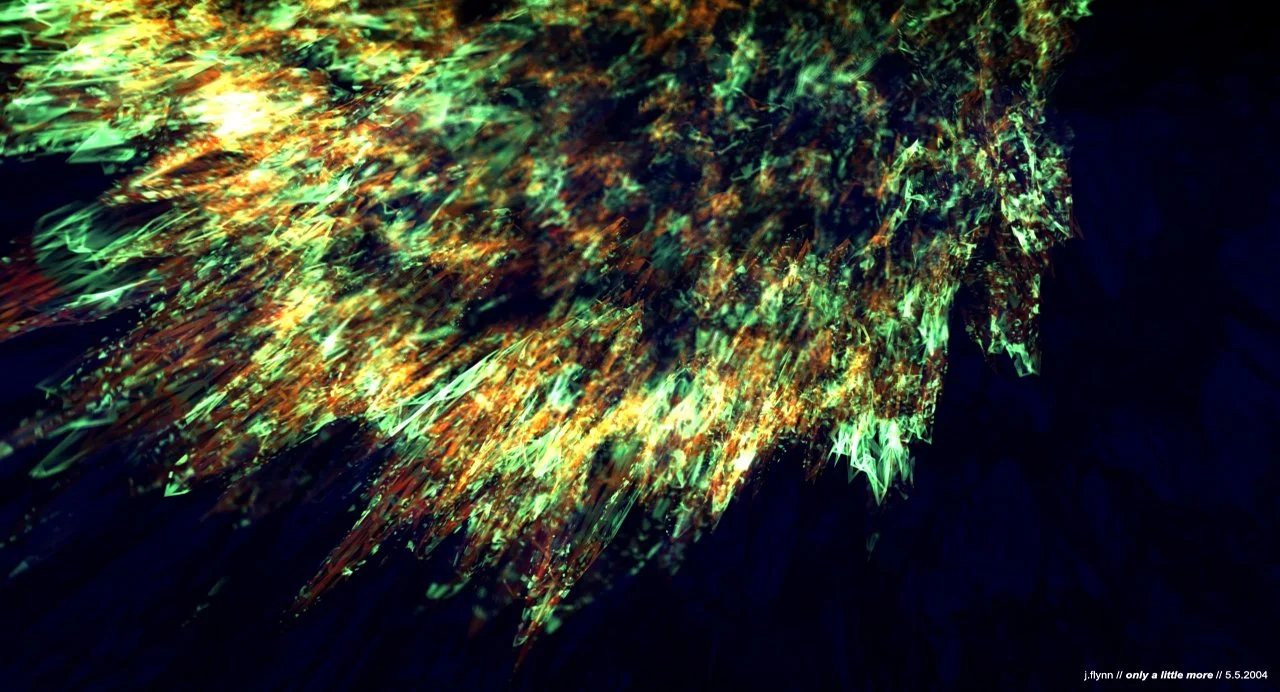
From about 1998 onward, you’d find me noodling around in 3DS MAX on the regular. Looking back at my output from the time, and considering how painful it was for me to reenter 3D design and animation as a professional a decade later (more on that in a future post), I’m kind of surprised by how much skill I managed to develop between my one book of lore and blind experimentation. For the most part I modeled with primitives, and most of my attempts at subdivision modeling (then called NURBS) were exercises in extreme frustration. But I’ll be damned if I didn’t sort out how to manage an animation timeline, parenting, lighting, even a bit of shader work that produced some renders I’m still pretty proud of.
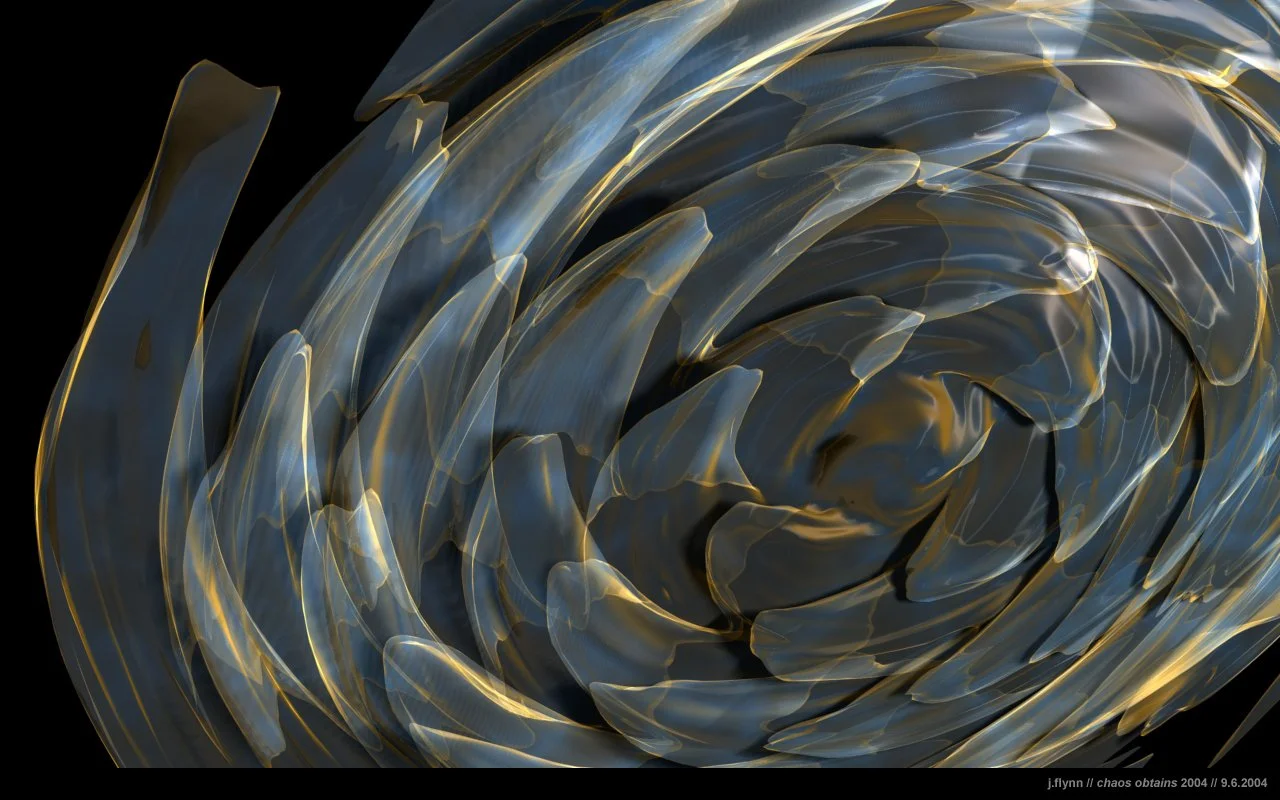
3D was on my toolbelt, at least casually, until 2006, at which point it fell entirely by the wayside and stayed there for the next six years. With no formal training or support to bolster my experiments, and my creative focus organically shifting into video production & post production during college, I found myself opening up 3D Studio less and less often. My last big fun 3D scene of that era was a desktop wallpaper I made while waiting oh so patiently for UPS to deliver my very first flat panel monitor:
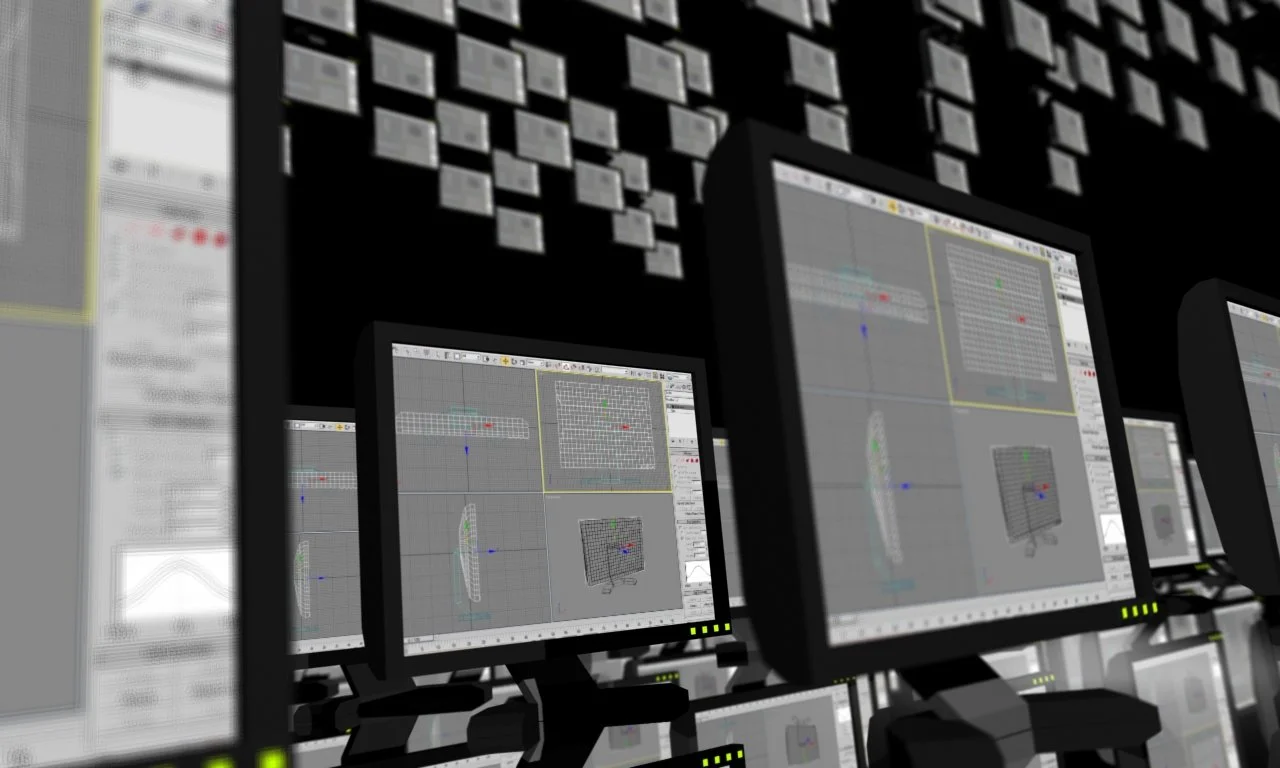
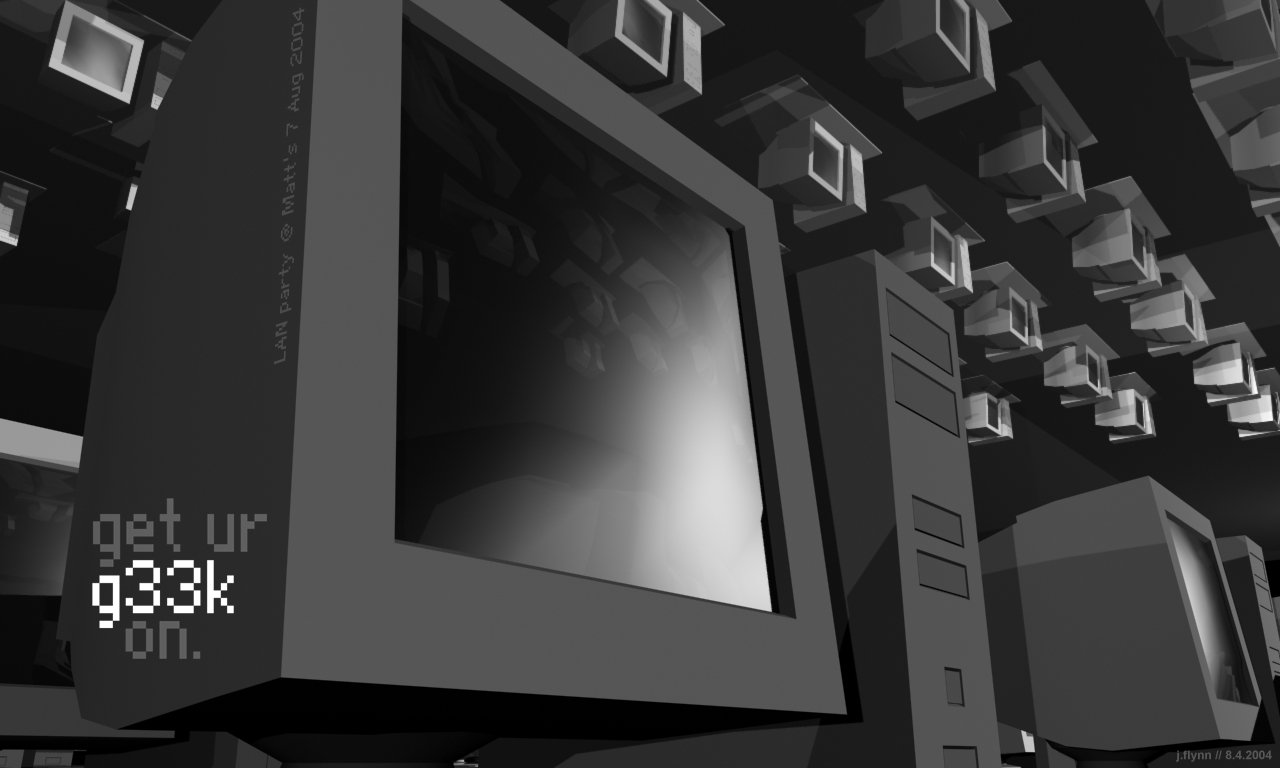
I’m grateful for the time I got to spend with 3D software early on, for the bridge it built between my childhood wonder at groundbreaking movies like Toy Story and the freedom to make cool stuff out of my own head with these amazing tools. I’m also grateful that my generation gets to bequeath tools like Blender—orders of magnitude more capable than what I was using at the time, and free—to anyone with even a passing curiosity about the art form. My journey in 3D design was a privileged one, born of an opportunity most kids at the time just never had, so it’s doubly amazing to see how accessible these tools continue to become.
Ave Maria / Bach & Gounod
This composition recorded March 21, 2024.
Ave Maria in C major - J.S. Bach & Charles Gounod
Moog Etherwave; Keeley Parallax; Korg NTS-1
Ave Maria was the first piece I really drilled down and figured out on the theremin. Apart from loving the melody, I felt it struck a nice balance between traveling the scale with an optimistic energy and maintaining a tempo I could keep up with at my early skill level. I still play this piece at least once in every practice, though I won’t say my execution has improved that much in the intervening two years!
I built the accompaniment for this recording myself, painstakingly in the dumbest way possible, by driving my Korg NTS-1 with hand-placed notes in my Cakewalk piano roll. I don’t play the keys, so unfortunately that’s how I do. As future theremin performance posts accumulate in this space, the gentle reader may notice I don’t make a whole lot of accompaniments myself.
1999 in living color.
It used to be that Windows was a DOS program that, like any DOS program, the user could quit. The line began to blur on the release of Windows 95, which inverted the user’s relationship to DOS by introducing “MS-DOS Mode,” a functionally real version of DOS that was actually more of a decoy or a shell. By Windows 98, we began to see the true zombification of DOS into a command prompt for doing Windows things, and our beloved DOS-native applications started to tire under the burden of competing with our fancy new 32-bit lifestyle.
It used to be that Windows was a DOS program that, like any DOS program, the user could quit. The line began to blur on the release of Windows 95, which inverted the user’s relationship to DOS by introducing “MS-DOS Mode,” a functionally real version of DOS that was actually more of a decoy or a shell. By Windows 98, we began to see the true zombification of DOS into a command prompt for doing Windows things, and our beloved DOS-native applications started to tire under the burden of competing with our fancy new 32-bit lifestyle.
So when our family computer was updated to Windows NT 4.0, it just didn’t make sense for me to keep fiddling around in QuickBASIC anymore. Now it was time to jump into the boundless possibilities of object-oriented programming, graphical user interfaces, clickable buttons! So yeah anyway I learned VisualBASIC 3.0.
I think the most useful thing I ever made with VB was a fifteen-minute timer. As I moved up into junior high and high school, my circle of friends quickly expanded beyond our phone service’s local calling area, and so my social existence survived on a lifeline of prepaid calling card credits that my parents re-upped like an allowance. I was allowed to make fifteen minutes’ worth of long distance calls per day on my card, and since the constant judgmental staccato of Mom’s kitchen timer really killed my vibe I decided to make my own little app on the computer.
But “useful” applications were pretty boring. Mostly, I was trying to build full-blown graphic adventures in the spirit of all the Sierra and LucasArts point-and-click games that overflowed my hard drive. Brimming with ideas, I started everything, and finished nothing, because cel animation is wicked hard in MS Paint and also my coding skills were (and continue to be) notoriously tepid.
I remember putting together exactly one screen of a point-and-click adventure game. It had all the bells and whistles—walk cycles for four cardinal directions, items to pick up, an inventory screen … but crucially, I had forgotten to come up with a story. That wasn’t a deal breaker for me; what ended up sinking the effort was my utter failure to code a path-finding function that would let my little avatar guy navigate around obstacles. That project was soon shelved, but I was still determined to make something out of the heavy tomes of game programming books I’d begged my parents for.
The Interactive Cinema is the closest I ever got to telling a branching story with graphics and animation. As with its point-and-click predecessor, I had absolutely no idea where the story was meant to go. The idea of planning the thing out in any way before diving straight into production never entered my mind, echoing nearly beat-for-beat the first few weeks I spent developing this very website. It was all jazz. Even though the thing was never finished, I did manage to save it and carry it with me for the better part of thirty years, and here it is.
The Interactive Cinema spent its first years on a small local hard drive, managed by a tween, with no backup. At some point, it made its way onto a 1.44-megabyte 3.5” floppy disk—again, with no backup—and there it languished for several years. It found a new home after the tween (now a teenager) received an Iomega Zip Drive, which, for readers who don’t remember, had its own proprietary format of 100-megabyte “Zip Disks.” From there, as the Zip Drive fell out of the zeitgeist, it was burned to a DVD-R, placed on a 100-disc spindle with other “backups,” and promptly forgotten for around fifteen years. It wasn’t until just a couple years ago that I, now a real grownup with a grownup offsite backup service for grownups, pulled all of those spindles of burned DVDs up out of my dank-ass basement and dumped their contents onto an eight-terabyte external hard drive that fits in a front pants pocket, because it is now the future.
Of course, now that it is the future, The Interactive Cinema doesn’t run.

I tried everything. Compatibility Mode. Safe Mode. I found a dusty old copy of vbrun300.dll and pasted that into a half-dozen important-looking places within my Windows 11 installation. No dice! Was I defeated? Had obsolescence slammed the door on all the cool junk I made before the world moved on from 32-bit operating systems? Nay! While today’s technology does its dangedest to coddle us and tell us never to tinker, this nerd still remembers the glory days when changing random values in autoexec.bat and jamming CTRL-ALT-DEL with a prayer could mean the difference between getting Warcraft 2 to start and having to play outside instead. I just had to pull out the big guns.
Armed with a very tall brewski and possessed of a couple late nights, I discovered a supercool emulation platform called VirtualBox, and an archived ISO for Windows 98 Second Edition. Before too long, I had an honest-to-goodness virtual machine booting into real Windows 98. The Windows Start sound made the hair on the nape of my neck stand up. From there, I just had to make a folder on my “real” computer, fool the Windows 98 VM into thinking it was a CD-ROM drive, and then use that flimsy hack to move cinema.exe over into its new 32-bit home.
It was only there, manipulating the past in a glass box through insulated gloves like an infectious disease researcher, that I managed to get cinema.exe running again. It was glorious! Unlike CARTOONZ!, my DOS-based first foray into digital animation, I was honestly shocked by what I managed to accomplish with straight-ahead animation drawn in MS Paint. I mean, just look at that weird green alien blob thing!
The Interactive Cinema was, without a doubt, the first crucial success in my journey as an animator. Sixteen colors, 650 kilobytes, and the validation I needed to keep on truckin’.
Getting into solo roleplaying.
The tabletop RPG scene has always been on my periphery, beginning with a stalled-out session zero of 2E Dungeons & Dragons in high school, of which the most memorable part was spent listening to my buddy attempt to explain THAC0. Fast forward to May 2025, and on the heels of a ninety-two hour playthrough of Baldur’s Gate 3, I thought it would be so awesome to give the hobby a proper try.
The tabletop RPG scene has always been on my periphery, beginning with a stalled-out session zero of 2E Dungeons & Dragons in high school, of which the most memorable part was spent listening to my buddy attempt to explain THAC0. Fast forward to May 2025, and on the heels of a ninety-two hour playthrough of Baldur’s Gate 3, I thought it would be so awesome to give the hobby a proper try.
Everything about the TTRPG hobby enchanted me. I’ve been a fan of fantasy and science fiction in literature, film, and video games since childhood. I loved the sound and flash of rolling dice, and the thrill of not knowing how they would fall. The libraries of rulebooks, sourcebooks, and settings, with their interconnected mechanics and statistics actually scratched my coding and animation itch—the exercise of setting up a character and running her through a crunchy combat encounter or skill check delivered the same flavor of satisfaction as pickwhipping the heck out of disconnected artwork until you’ve got a dynamic character puppet to animate. Exploring the many and varied approaches to simulating (or at least adjudicating) completely open-ended actions was like kicking off a massive Rube Goldberg machine and discovering all the weird, unexpected results you get out of the other side. And with all that scaffolding established, I am at heart a maker and a storyteller. TTRPGs were made for me.
Of course now I’ve got a spouse and a kid and a job, and yeah, so do all of my closest friends, so for a hot second it felt like the ship had sailed. I considered joining a local group, but that would require meeting New People and that’s not my favorite. So what’s a nerd to do?
That’s around the time I discovered solo roleplaying: all the dice and rule books but without a group or a game master. It’s a thing! For the uninitiated, here’s how it works:
Find a system that sounds fun.
There are a few TTRPG systems that are specifically designed for solo or co-op play without a Game Master. Ironsworn and its sci-fi cousin Starforged are great examples. In that style of solo play, world-building is procedural (rolling dice on tables to determine the “Truths” of the world and help kickstart your story), and events that are outside of the player’s control (think NPC behavior, random encounters, the results of trying a creative action with an uncertain outcome) are guided by “oracles,” specialized dice rolls to answer yes or no questions and draw keywords from themed tables to help you figure out what happens next.
Many other systems, like Shadowdark and Cyberpunk RED, have official rules for solo play. Those rules generally follow the same oracle-based approach to not playing with a GM, while also making tweaks to some of the group-play mechanics to ease the bookkeeping burden, or balance the difficulty of combat encounters. It’s also not uncommon for the player community to publish unofficial solo rules for games that don’t include them, for example Solo_Work for CY_BORG or A Lonely Death In Space for Death In Space.
Choose a GM/oracle method
What if the game system you want to try doesn’t have any solo rules? Or what if the official solo tables get repetitive or boring and you need to juice up your inspiration engine? Now we’re talking about bringing a GM Emulator into the mix.
In my play I have grown very fond of the Mythic Game Master Emulator 2E by Tana Pigeon. Not a game unto itself (unless you want it to be! There are rules in the book for that!), Mythic instead sets out an easy-to-digest system of oracles and procedures that can be applied to any RPG system you want.
If Mythic isn’t your cup of tea, there are also specialized decks of cards and methods of using standard playing cards or tarot cards to stand in for a GM. These methods come with less structure and lean more heavily on your own creativity to push your story forward.
I have also become a big fan lately of Man Alone’s Prima Materia, which threads the needle between a system with tables of concrete prompts and the super open-ended interpretation of cards. Prima Materia is now my go-to for squishier issues like determining how non-player characters in my story are feeling about a subject we’re discussing, or digging myself out of a hole where I just have no clue at all where to go next.
Choose an expression of your play
Here’s where solo roleplaying really stands on its own as a distinctive hobby. Roleplaying games, played in a traditional group setting, are an exercise in collaborative storytelling. The GM sets up the pins (quests, story hooks, some key NPCs to interact with) and it’s the players’ job to work together to knock them down. The magic then comes from the group dynamics: the players don’t know what their GM will throw at them, and the GM can’t predict every action the players will take in response. While there are absolutely gamey elements that vary from system to system—mechanics for combat, negotiating with NPCs, exploring uncharted lands, etc—at the very foundation of the hobby is telling a story. It may seem at first like you need a group to create that feeling of a living, breathing, evolving story, but for real, you can do that all in your own head; in fact there’s a game for that. But what if you like drawing maps? Go nuts; there’s also a game specifically for the cartographically inclined. You can also novelize or journal your experience (and yep, there are games that lean hard into that as well, see Koriko: A Magical Year or Ion Heart), or just keep a shorthand of what your characters get up to and what happens next.
For my practice, I start with a pretty verbose log of what’s going on. Part of my fun is the creative writing exercise of coming up with dialogue, describing events longhand, but if I’m caught up in the moment I’ll let some detail fall by the wayside. I also like to record all my dice rolls and oracle questions; at first this was a deliberate move just to help me learn these systems, but I keep up with it because I love the artifact it creates.
Beyond the log, I have allowed the hobby to reignite my love of drawing. I’m all about making detailed hex maps, battle maps for especially consequential encounters, and I’ve even started to include drawings of scenes or characters when I’m feeling so inspired.
If that sounds like a lot, it is. But none of it is required! In solo play, you’re accountable only to yourself, so add or remove rules, tools, or expressions of play from game to game or session to session.
That’s pretty much it.
I plan to add lots of resources over in the Links section where you can learn more about this quirky subculture.
I learned to code in 1996.
First it was a branching choose-your-own-adventure situation built with Automenu, but when that wasn’t enough, my father gave me a two inch thick book on programming in QuickBASIC and I got to work.
First it was a branching choose-your-own-adventure situation built with Automenu, but when that wasn’t enough, my father gave me a two inch thick book on programming in QuickBASIC and I got to work. At the time, my best friend had already started coding in QB thanks to his own dad’s urging. I can’t remember what kind of programs he was writing at the time—games, I assume, probably text adventures— but, not to be outdone, I resolved to start making digital animation, even though coding graphics was way over my head. Undeterred, I created four installments of CARTOONZ.BAS, a series of little vignettes made of what could be generously referred to as ASCII art. The animation ran at one frame per second because 1 was the lowest value QuickBASIC v4.5’s SLEEP keyword would accept, and now we all need to suffer through that together.
I credit the ASCII-based dungeon crawler NetHack, which I witnessed with pure wonder at another friend’s house long ago, for showing me how complex ideas could be expressed through quick, accessible symbols. A pipe ( | ) could be a hero; aliens could be pound signs (this predated the concept of a “hashtag,” natch); shapes could be made from hyphens, underscores, and slashes. The possibilities were nearly endless, and of course I never even scratched the surface of the truly amazing ways an artist with enough patience could leverage extended character sets.
Unfortunately the uncompiled code no longer exists, but these little programs were so hacked-together that I can still remember how they were built. Behold, the code for a single frame of BUNGEE:
CLS
PRINT
PRINT ^^^^^^^^^
PRINT         ^
PRINT         ^
PRINT         ^
PRINT         ^
PRINT         ^
PRINT         ^
PRINT         ^
PRINT         ^
PRINT         ^
PRINT         ^
PRINT         ^
PRINT         ^
PRINT         ^
PRINT         ^
PRINT         ^
PRINT         ^
PRINT         ^
PRINT         ^   SPLAT!!!!!
PRINT         ^   __
PRINT ^^^^^^^^^^^^^^^^^^^^^^^^^^^^^^^^^^^^^^^^^^^^^^^^^^
PRINT
SLEEP 1
It’s funny, when I first rediscovered these old compiled BAS files, I was first struck with a memory of some kind of super cool animation that I’d managed to pull off. Surely, even at just one frame per second, there was something, some tiny nugget, that foreshadowed the skills and instincts I’d go on to cobble into my rewarding career? Not so much. It turns out, what I was remembering was merely the satisfaction of completing an overwhelming effort. It was hard work forcing my will upon poor, unsuspecting QuickBASIC. And with my vision fogged by the sheer toil of it all, I had no idea how simplistic the results actually were.
I think that’s actually my favorite part about CARTOONZ!. They suck. They are an order of magnitude more lame than every subsequent effort I’d go on to make, both as an animator and as a coder. Beyond sucking, though, they were, unapologetically, what creativity accomplishes under constraints. It was a labor I committed to, with no acknowledgement before or after of the cavernous gap that existed between the art I was consuming and the art I was making. Of course now, both due to decades of experience and just being a jaded old guy, I live almost constantly on the bummer-side of the Gap, working feverishly to force even a rickety old rope bridge to span to the other side. But in re-watching CARTOONZ!, I sincerely hope that every young creative mind gets to have that period of unexamined abandon. At the time, I made CARTOONZ! because I wanted to do what my friend was doing, and I wanted to make animation. Now, I’m glad that I made CARTOONZ! because it can remind me that the Making part is allowed to be valuable even if the thing that is made truly sucks.
The obligatory AI post.
Judging by the proliferation of tantalizing little “spark” and “thought bubble with rotating gradient” buttons we now see in almost every context imaginable, applications of LLMs and generative AI are seeping into every little crack and crevice, a scintillating solution hungrily searching for a problem. In fact, there’s one chillin’ in my text formatting toolbar right above me as I write this, and I know there would be at least one more of them at the top of my screen if I hadn’t recently switched from Chrome to Firefox. So how does a creative professional such as myself wade through this brave new world?
Let’s get the TL;DR out of the way: I don’t dig it. When speaking specifically about consumer-facing AI products and services, I think it is a fascinating development in computer science which has not yet found a practical value to offset its drawbacks. Each AI product’s logo, for now, may as well be a Bored Ape [unique, edition-of-one]. That said, as an extension of this site’s unusually succinct AI Policy, I take this time to reflect on the ways in which this technology intersects with my hobbies and career, as well as with the creative industry at large.
“Case studies,” if you’re nasty.
I will lead with a cross-section of the first-hand experience I’ve had with AI tools:
When I was preparing the Links section of this very website, I had a problem: I’d collected loads of links, and I had done so without any thought as to how they should be organized. I decided it made the most sense to alphabetize them, but unfortunately neither the Squarespace text editor nor Google Docs had a built-in function to sort a list. Before committing to copypasting everything into a dang spreadsheet, alphabetizing the list, then round-tripping everything back into the post editor, my eyes wandered over to the inviting little Squarespace AI button. When I clicked it, the prompt asked, “What do you need?” So I highlighted my content and asked it to alphabetize my list. The results? A new list, from whole cloth, of random links to various places, that were (checks notes) not alphabetized.
A while back I was on a client job where I’d been provided a stock photo of the front door of a house. Visible in the photo were the stoop, a sort of awning over the door, a window on either side, the front walkway, and a bit of lawn. It worked great for my purposes, until we had to reflow the animation from its original 16×9 aspect ratio for a 9×16 deliverable. Now there was all this negative space on the top and bottom of my image, and the original photo was just tight enough that finding enough source material to clone stamp more content in the traditional way was futile. But hey—Photoshop’s Generative Fill had my back! I prepped a larger canvas, prompted, “Please extend the house and lawn,” and lo and behold, a perfect set extension.
My son recently finished first grade, and came home with his report card printed on a 8.5×11 sheet of paper, folded into quarters. I like to keep his progress reports in a shared Google Drive folder, but I couldn’t find a PDF of the document in his school’s online portal, so I figured I’d just scan it with the Drive app. The day before attempting this, the non-AI version of Drive’s document scanner did a tremendous job detecting page edges on a medical bill I had to scan; this day, the new AI replacement insisted that the folds in the page were in fact gaps in a set of four pages that I wanted to make a multi-page PDF out of. There was no obvious way to convince it otherwise, so I had to spend fifteen minutes furiously DuckDuckGo-ing how to revert to the old version of the scanner.
In one early session of my Shadowdark campaign, my party encountered a cross between a leprechaun and a genie called the Wandering Merchant. I wasn’t going to buy anything from him, but still wanted to get some kind of value out of the encounter since he pops up very rarely. So I decided, this guy knows lots of stuff, maybe I can get some kind of a prophecy from him? Thing is, when you’re solo-roleplaying a system that’s traditionally played with a game master, coming up with cool narrative twists out of thin air can sometimes be arduous and unsatisfying. I rolled some dice on one of Shadowdark’s random tables for a Boon and got the result the weakness of a mighty sorcerer. It was a cool hook, but I wanted to feel like this prophecy was being given to me, not just to my characters. So I held my nose and asked ChatGPT for details:
Good morning!* I am playing Shadowdark RPG, a tabletop roleplaying game with a dark fantasy setting. A wandering merchant has just offered to tell my character the secret weakness of a powerful sorcerer. I have not met nor heard of this sorcerer yet, but the merchant is somewhat magical and a little prophetic, so it's fair to say I'll need this information at some point in the future. Can you please make a list of 12 potential weaknesses this sorcerer may be keeping secret? The options can be mechanical (for example, attacks with certain weapon types or magic deal more damage in a fight) or narrative (for example, the identity of the sorcerer's estranged child, who could force the sorcerer to see reason and avoid a conflict)
*I have a policy of always being polite to LLMs and other digital assistants for three reasons: I choose to set an example for my young son that there’s no kind of [person/thing] who, by their nature alone, is inherently deserving of a dickish attitude; I know that it costs billionaire-backed AI companies very slightly more to have their models parse my polite language compared to a straightforward command and that’s funny to me; and I am absolutely sure that some version of what we’re building here will one day become sentient, and I don’t see any benefit in being remembered by a new life form as one of the millions of utter assholes who yelled at it for no reason.
… And I’ll be damned if ChatGPT didn’t make me the coolest random table I could have ever asked for. When I rolled my d12 to pick one of the results, I would have been pleased as punch with any of the hooks I landed on, but what I did end up with has become one of the narrative cornerstones of my campaign for an entire year.
The Holodeck Problem
I think the thing I hate most about AI is that it has become the monkey's paw version of something we've been begging for since Star Trek: The Next Generation. We were promised flying cars, hoverboards, laser guns, and got none of that stuff. But what we have in AI is an awful lot like the Holodeck on the Enterprise, and that's kind of incredible. With the Holodeck, one simply tells the ship's computer what one would like to see, and the Holodeck can vibe it up. Maybe it's a pre-built program like an interactive Sherlock Holmes mystery or a training simulator, but you can also just get in there and prompt engineer a universe for yourself. No one on the Enterprise contemplates any ethical concerns with this pastime as they careen through the Final Frontier. Isn't our generative AI basically the same thing?
Setting aside what did in fact go super wrong on the Holodeck, from Moriarty escaping the program entirely to Lt. Barclay merging his dumb consciousness with it, I think a couple of key differences between the Star Trek universe and our present reality lay bare some of the major issues we're facing.
Firstly, the Federation is a post-money society. Thanks to replicator technology, among other advancements, every Federation citizen has their basic needs met, and so “careers,” such as they are, are pursued out of a sense of duty, altruism, or natural curiosity. Within that context, there might be less of an ethical concern about training the Holodeck on the creative output of Federation citizens. Does our concept of intellectual property even exist in the 24th century?
Secondly, they've got dilithium. Energy is definitely not a problem for the Federation (except when it is), and anyway we’re talking about a society in which we have a warp drive on the same circuit as the Holodeck, so powering Barclay's fantasy garden isn't making a huge dent in the power bill.
Thirdly, scarcity. The Holodeck is an installation, a massive room requiring a huge amount of local IT infrastructure to run. Gene Roddenberry was fine with allowing the crew of the Enterprise to use the ship’s computer remotely via voice commands, not unlike Google Gemini or Apple Intelligence on a smartphone, but he never contemplated that the level of generative power offered by the Holodeck would be portable. I wonder if we’d have somewhat fewer qualms with our various AI applications if there was some scarcity—scheduling, queues, physical presence—rather than weaving the tech completely into the everyday actions of [waves hands without sources] two-thirds of the earth’s population.
The ethics things.
The sexiest-looking stuff AI tools have been tasked with rot the affected industries from the inside. So far, none of these things can out and out replace a senior-level practitioner in a craft, but the tech can take a significant bite out of the kind of assignments that entry-level and junior humans absolutely depend on to develop skill, taste, and experience. These juniors will have no choice but to generate and vibe their way through a critical period in their early careers, potentially leaving us with a generation of makers who don’t understand how their tools work. Though their creative engines may be unbound by the constraints of time and technical skill, they will be less prepared to pivot when their generative assistants fail them. We must regulate AI to protect the healthy development of young human professionals.
AI steals. It has got to be common knowledge by now that none of these toys work at all but for the collective output of uncompensated humans that the various models are trained on. This technical reality does not have to be evil, but right now it totally is. Copyright law has not yet evolved to adequately control for this, just as it struggled (and continues to struggle) to adapt to the digital age writ large, but in the absence of some massive paradigm shift in how we view the concept of ownership, the fact remains that a few wealthy people are getting even wealthier because their product is made out of stolen materials. We must regulate AI to protect the intellectual property of hard-working humans.
Data centers are bumming everyone out. They drive up energy consumption wherever they pop up, and that’s putting unforeseen stress on the grid even as it raises prices for their neighbors. Not all the energy these places consume is renewable, either, so our reliance on fossil fuels must increase to meet the demand. And the impact is only projected to rise. Oh, and they’re loud. We must regulate AI to rein in its outsized energy demands and ensure that data centers’ consumption does not raise prices for humans.
AI and my animation career
Now I’ll step off the more general societal soapbox and onto my How Does This Affect Me soapbox. AI intersects with my professional life in a zillion ways already, with more and more tendrils weaving into the job as the weeks pass. In the spirit of the big question posed by Why Make Stuff?, I want to put a stake in the ground on a couple of points.
Will I take work from clients who make AI-related products? Luckily, as of this writing, I am an employee, and I don’t choose my clients. Love a tidy answer! But that’s cowardly. The greater truth is that the team at Rove, my employer, is terrifically sensitive on this topic. Since a huge part of the client base for animators comes from Big Tech, we regularly accept work from clients that involves AI products. However, we would likely not take on projects for overtly evil clients (AI-related or otherwise), or further a client’s direct efforts to displace human labor.
The truth is, AI technology will succeed or fail on its own merits in its own time, and while we wait to see how that plays out, we’ve got human clients seeking to hire humans to make stuff, and that’s what we want, so why would we complain? We (as a studio, and I individually) place so much value in our client relationships, and so long as nobody’s asking us to make truly evil stuff for doing evil, we’re an enthusiastic group of humans open to help all good humans to be successful.
Will I use AI in my work? The short answer for now is only when required. The only reason I stay in this business is because I get satisfaction from process; short-circuiting that with AI middleware runs neatly counter to my entire philosophy of work. There is talk that the creatives who will survive this not-quite-a-revolution* are those very senior-level artists who leverage AI tools to increase their output, offsetting the race to the bottom spurred by other, client-facing AI tools that make creative work that’s “good enough.” For my part, when the only way I can survive in the industry is by becoming a slop-churn, then I think it’ll be time to find a new career path.
The hyperbolic drama-queenery above specifically applies to AI tools that generate what I’d consider “final image” assets, i.e. I’m not keyframing my animation; I’m prompting it. By contrast, I am optimistically watching the horizon for AI applications that effectively tackle tedious or impossible technical tasks, like After Effects’ Object Matte tool or Topaz’s AI-powered video up-scaling. I won’t put all my eggs in such baskets, however, unless and until they are ethically trained, or, such as in the case of the Object Matte tool, Adobe wholesale replaces a non-AI function with the new thing and leaves me with no option. ¯\_(ツ)_/¯
I’m also really intrigued by artist-led efforts to use AI for vibing workflow tools, like what Jake Bartlett’s doing over at Motion Lab and how Black Math is using ComfyUI to “mind-map” its entire pipeline. If it helps me iterate faster but stays well away from doing the fun part, let’s say I’m listening. Although, even in these cases, I’ll point out that coding expressions and scripts for After Effects is a fun and useful human skill, and pipeline management (slick GUI notwithstanding) is a whole human job. Developing expertise peripheral to one’s main thang is hard work that takes time, but that’s kind of what this whole website is here to celebrate.
With all that said, sometimes the line does get foggy. I was recently on a client project where the whole point was to showcase what the client’s generative AI product was capable of. It was meant to look like a live action shoot & edit style commercial, but we weren’t going to shoot anything, not even for casting. Front to back, the entire footage acquisition pipeline was steeped in AI, and while we hired a freelance “AI filmmaker” to lend their workflow & prompting experience to the cause, some of the generation work also fell to our staff. Admittedly I rolled my eyes more than a few times over the project’s lifecycle, as the results evolved to be neither as good, as fast, nor as cheap as a live action shoot would have been, but I didn’t object to being a part of it. Because it was effectively a demo of specific AI tools, no human actors or crew were displaced, and the entire post effort was driven by humans. And while I’d have preferred to use tools that were ethically trained and environmentally conscious, while producing results comparable to the dirtier methods, those are technical nuts that the computer science nerds have yet to crack.
*The key quote for me: “During the Industrial revolution, the machines that made stuff made better stuff than the craft-workers before them … the things that AI does, at least at this point in its evolution, aren’t nearly as good as the things that they replace.” -Jonathan Rees, Ph.D., CSU Pueblo)
In 1991, a world of anthropomorphic cats needed a hero.
… So I made dozens. What started with an innocent second-grade assignment, to think about two different animals and draw what it might look like if they were combined, became a years-long, nigh-pathological worldbuilding exercise.
… So I made dozens. What started with an innocent second-grade assignment, to think about two different animals and draw what it might look like if they were combined, became a years-long, nigh-pathological worldbuilding exercise. Batcat came first, followed by Catman, Cybocat, Scratch-Off, Ninjacat, Slapcat, and, of course, Supercat. It didn’t end with cats in costumes; soon Scratch-Off was sharing his love of gardening, Cybocat starred in a sprawling (by third-grader standards) plan for a cinematic video game, and Kitty Katt (certified genius in the mold of Peter Parker) was the subject of a somehow yet-to-be-produced stage play.
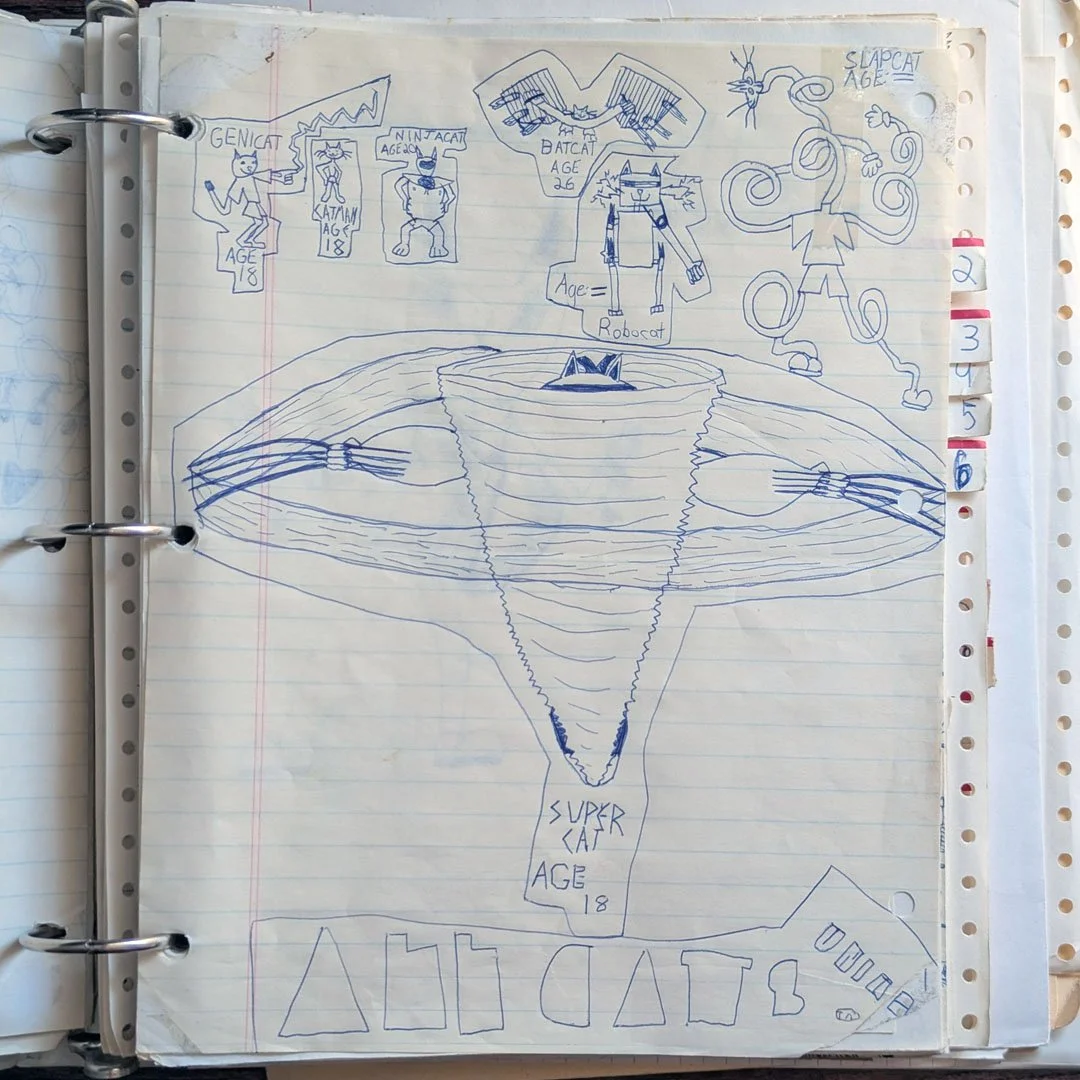
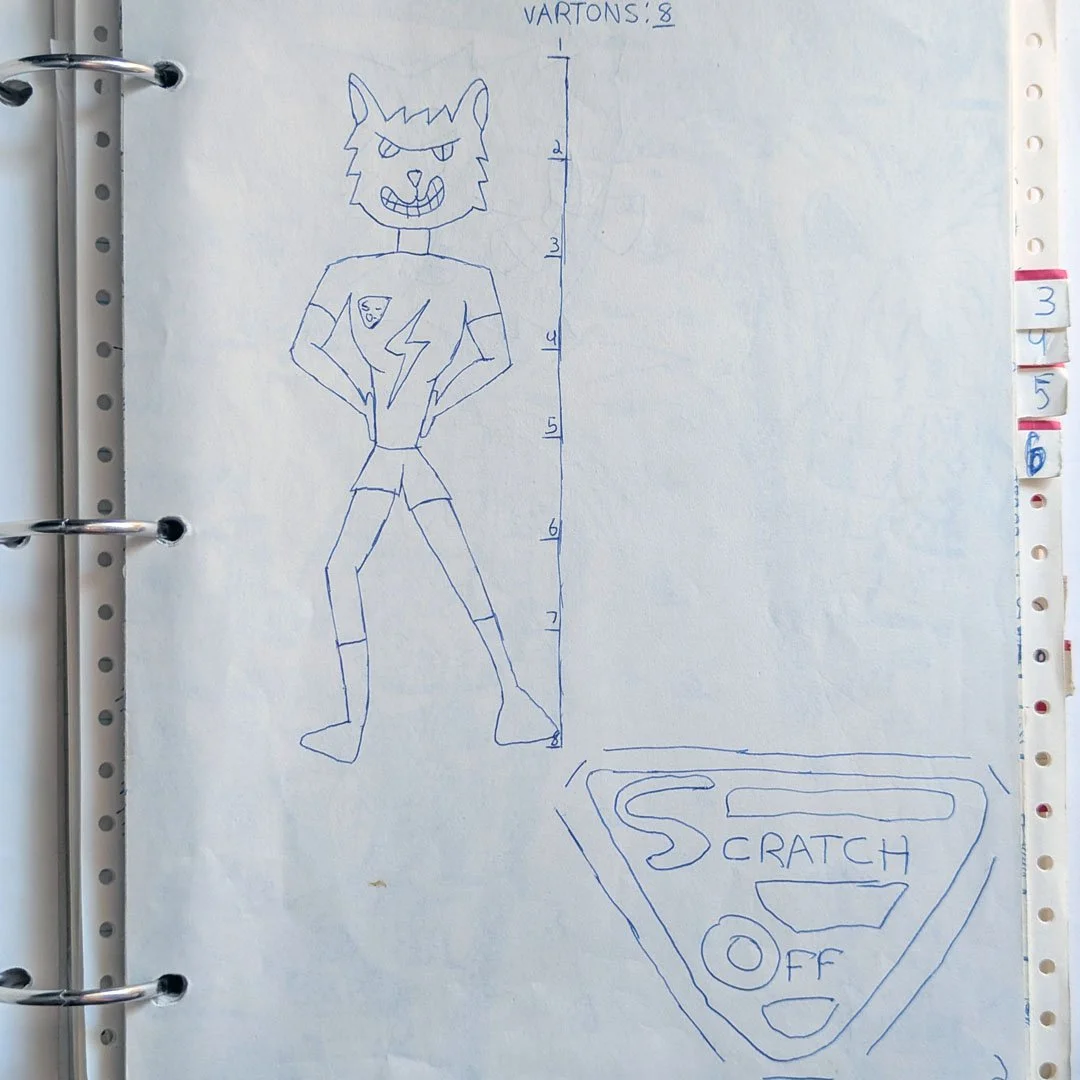
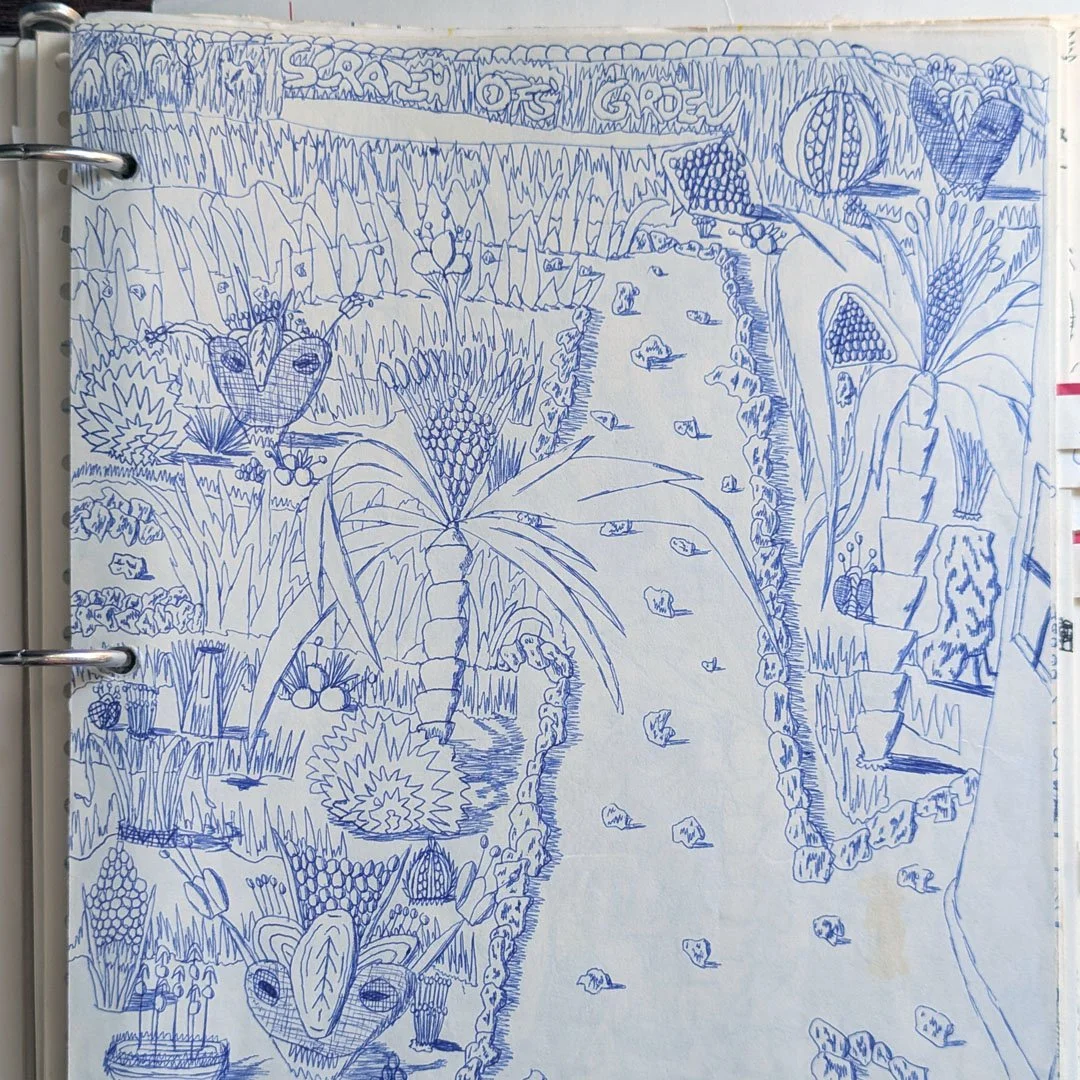
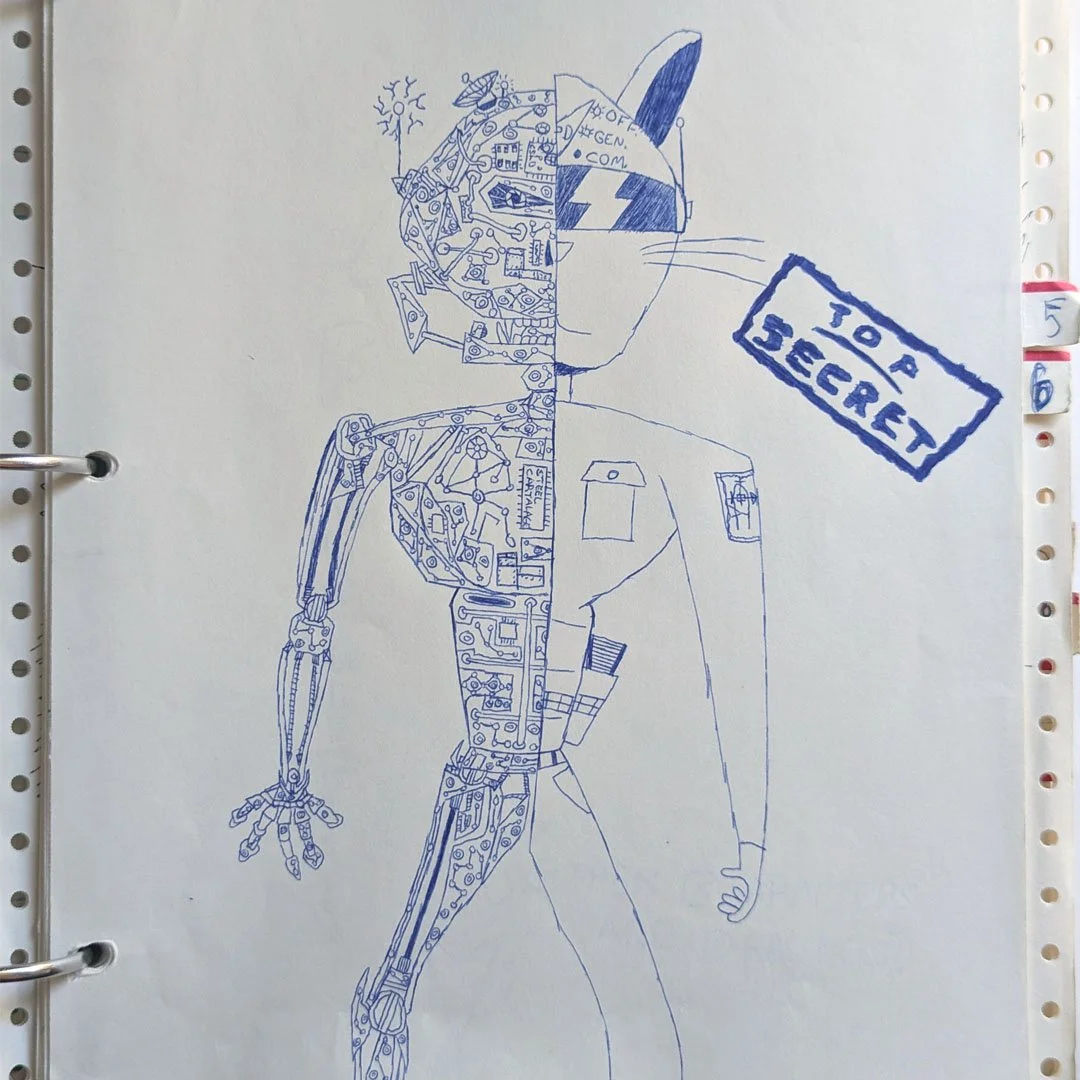
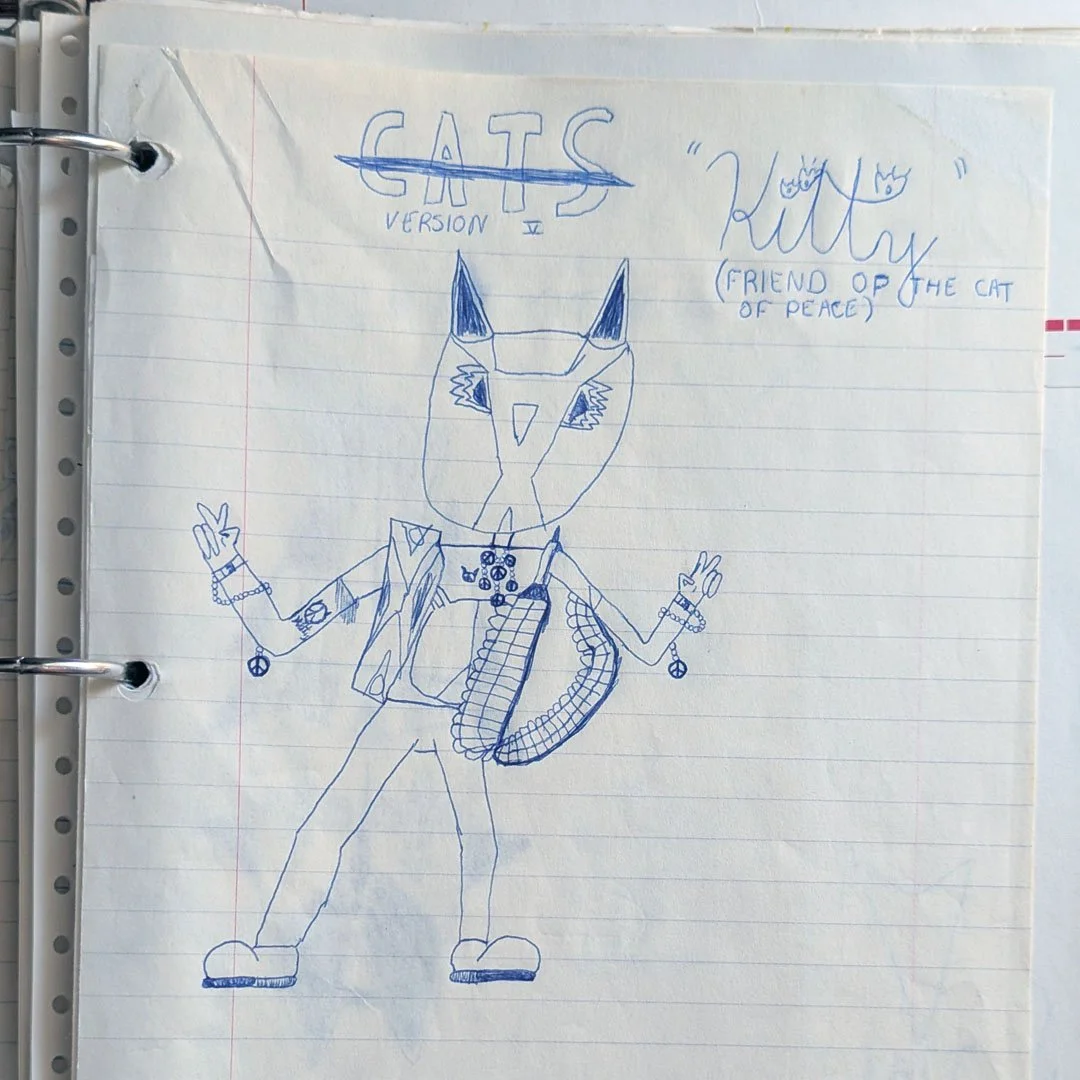
Said one fifth grader in 1994, “Jared’s going to grow up and marry cats.” Which was a silly thing to claim, as the milieu did not contemplate interspecies relationships even once; it was cats all the way down. I hope that through the great rear-view mirror of time and experience, that now-fortysomething understands how ridiculous they sounded.
Insofar as I can actually remember my “process” as an artist from ages 7-12, I believe I was certain all of these concepts were completely original. And yet with a fresh eye, almost every character, and even some compositions, were lovingly lifted from media influences. Scratch-Off was definitely a response to Bubsy; Cybocat was a G-rated Robocop; Slapcat was Mr. Fantastic; and I’m pretty sure that Kitty and his ripped-denim-clad band The Cats were an amalgam of any of the hair bands my parents played on the local classic rock radio station. Stories were mirrored almost beat-for-beat from Power Rangers and VR Troopers. Whole drawings responded to key art from Wolfenstein 3D and any number of Sierra’s point-and-click adventures.
There was a period, long after all this art was made but way before today, when I felt embarrassed or regretful about how imitative my artwork was. But revisiting these characters through the lens of being a dad to an eminently creative kiddo has brought all these old drawings into a new kind of focus. Good artists copy; great artists steal is a fun adage that’s often attributed to Pablo Picasso, and was subsequently copied and stolen by any number of people from T.S. Eliot to Steve Jobs, and there’s a wisdom there worth stealing.
As I watch my son build worlds in his supercharged imagination, a pattern emerges: new details almost always mirror stories and media he’s recently experienced. He created a race of hyper-intelligent birds, born after our family invested in a big full-color bird reference book and we started using Merlin to identify all the songs in our backyard. We find out how his birds teach their young in a big college, and descriptions of the school’s faculty map suspiciously over characters from Monsters University. The birds become militarized against the tide of human colonialism after conversations about the European colonization of North America. Following a trip to the Boston Tea Party Museum, they mount an ongoing conflict to claim their independence following the American Revolution’s playbook. Most recently, we got to see the first fully-rendered map of the civilization the birds built for themselves in the age before the human invasion, and it looks suspiciously like the maps I’ve shown him from The Lord of the Rings and the hexcrawl I’m developing in my Shadowdark campaign.
This seamless and shameless folding-in of new inspiration into the kiddo’s imagination-continuum is a great illustration of how we all work together to push art forward. For as long as a kid’s drive to create outpaces their context and experience, every doodle and story becomes a window into their journey of synthesizing new information. It’s no different for us grownups, and it was my son who called me out on precisely that fact: while sharing the fiction from my Shadowdark campaign with him recently, he pointed out that the writing sounded just like what he was used to hearing in Lord of the Rings. Without realizing it, my practice of reading LotR aloud to our family started to flavor my writing style. Guilty as charged!
Why make this website?
Many months ago, I started asking myself what I needed or wanted from a web presence. Was a grid of case studies and a nice headshot enough? Was there more going on in my life that felt fun to publish? At the same time, I found myself contemplating some scarier questions about the trajectory of my career as an animator. Was I still passionate enough about the work? How much of my identity does my work deserve to occupy? Is pushing keyframes around still joyful, or is there a higher platform in this space to which I ought to climb?
I pen this inaugural blog post from a position of extreme privilege: I’m happily and gainfully employed at ROVE, a true unicorn of a studio, and therefore there’s almost a negative pressure when it comes to marketing myself. At the same time, my old portfolio website had been stagnant since 2018 and it was starting to feel silly to keep up with the fees.
Many months ago, I started asking myself what I needed or wanted from a web presence. Was a grid of case studies and a nice headshot enough? Was there more going on in my life that felt fun to publish? At the same time, I found myself contemplating some scarier questions about the trajectory of my career as an animator. Was I still passionate enough about the work? How much of my identity does my work deserve to occupy? Is pushing keyframes around still joyful, or is there a higher platform in this space to which I ought to climb?
These questions simmered long and quiet, evading concrete solutions with each bubble and snap, but eventually I was thrilled to discover the sweet syrup of a decent idea: to build a place where it’s safe to examine the why of a creative life; where clients can find my reel and case studies without friction; where colleagues and professional peers can find some shop-talk; where friends and family can keep up with some day-to-day stories; and where any old Internet rando who stumbles in can witness the authenticity of another Internet rando.
This website could have been a TikTok
Or a Bluesky, or a YouTube channel, or I think Tumblr is still rockin’ as well. In any of these cases, getting started would have been 100% less expensive and probably 80% more convenient. I could have connected with friends and colleagues already on the platform and grown a following and maybe even monetized. Instead, perhaps in protest of all that, I’ve chosen to maintain a small corner of the World Wide Web and host at least two blogs on it (eventually) for fun on my own dime. It’s not a shot across the bow of today’s digital ecosystem so much as straight up in the air, in the dark, and my reasons are legion.
Social media is ephemeral, at least until you end up running for public office. Generally, social media platforms don’t actively encourage an audience to dig through a creator’s post history for new stuff. YouTube is one notable exception (at least for now), but Facebook, and most of its feed-based peers, would much rather offer up sponsored content ad infinitum than dredge up old posts from your actual friends. History is not optimized for discovery on these platforms, and that runs against my goal to hand visitors “the key to my garage.” Instead, my invitation is to come, poke through my cardboard boxes of stuff from back when I was cool, and then go touch some grass.
Working the Algorithm does not feel like a fun time, either. Quoth Boromir, “One does not simply build an audience on social media.” After coming up with a sick idea to share with the world, you’ve got to move heaven and earth to make it surface. Then you’ve got to make an appeal for engagement. And then you’ve got to keep producing content on a cadence that maintains whatever momentum you manage to create. It’s literally a full-time job you can get a degree for, and with no judgment at all against professional social media managers and strategists, it’s not a job I choose for myself. Certainly not for the purpose of sharing my TTRPG actual plays or off-key theremin recordings.
A question with many answers
Sometimes the answer to Why Make Stuff? is Because A Paying Client Asked Very Nicely, and that’s okay. For those modes of creative expression that I have chosen to trade in professionally, it’s as noble a cause as any. I’m proud when my efforts help my clients meet their goals. Since there is always a certain ego attached to making stuff, I will not shy away from examining the real-world value of the client work I do when such inspiration strikes, but Trading Effort For Food And Rent is not a cynical motivation, and actually I believe that would be a toxic position to take. Stay tuned for a longer discussion on my philosophy of work sometime, maybe.
Other wonderful answers include To Help People; To Teach People; To Strengthen the Team; To Learn How To Make Something New; or To Synthesize New Information. A perennial favorite answer is I Had Some Time To Kill ¯\_(ツ)_/¯. Answers like these often overlap with the Paying Client answer (in fact, the best Paying Client situations are those which blend with any of these others!), but they work great on their own, too. Nobody but nobody is asking me to blast my theremin amp out into the neighborhood; that’s just for me, and also something I subject my family to sometimes. Incidentally, often my best theremin answer is I Need More Excuses Not To Sit and I like to think that’s a pretty worthy answer.
The metaquestion
Behind all this is the big one: Why Why Make Stuff? There’s no single answer to that question, either, and that’s what I hope will keep this space feeling dynamic as I get into the groove of updating it.
One answer is that this place is a mindfulness exercise. Similar to taking a moment to search for gratitude in our daily lives, I am betting that taking time to examine the Why behind my creativity will help me both appreciate what I’ve already produced, and firm up the ground beneath me to launch into each next thing with more purpose.
Another answer is that I’m nostalgic for an Internet that invited discovery without the burdens of monetization, algorithm optimization, doomscrolling, fencing users into particular platforms, or any of the other pillars of enshittification that are all so pervasive these days. I choose to trade the implicit motivation of participating in social media to gain followers (inherently narcissistic behavior, in my view) for an exercise in screaming into the void and perhaps not ever knowing if anyone hears it (so, good old-fashioned self indulgence, instead).
In the end, I just think it would be rad if some youths found this place, saw some thirty-year-old drawings of anthropomorphic cats and twenty-year-old Flash animations next to award-winning motion design for some big brand, and decided they had what it takes to get into the industry. And if they think someone they know would think this stuff is cool too, they’ll text them a hyperlink. Then maybe those same youths will start blogs of their own showcasing their unique interests, and they’ll point here on their Links pages, and I can reciprocate, and we’ll have reinvented the webring, and it will be a Good Fuckin’ Day on the Internet once more.